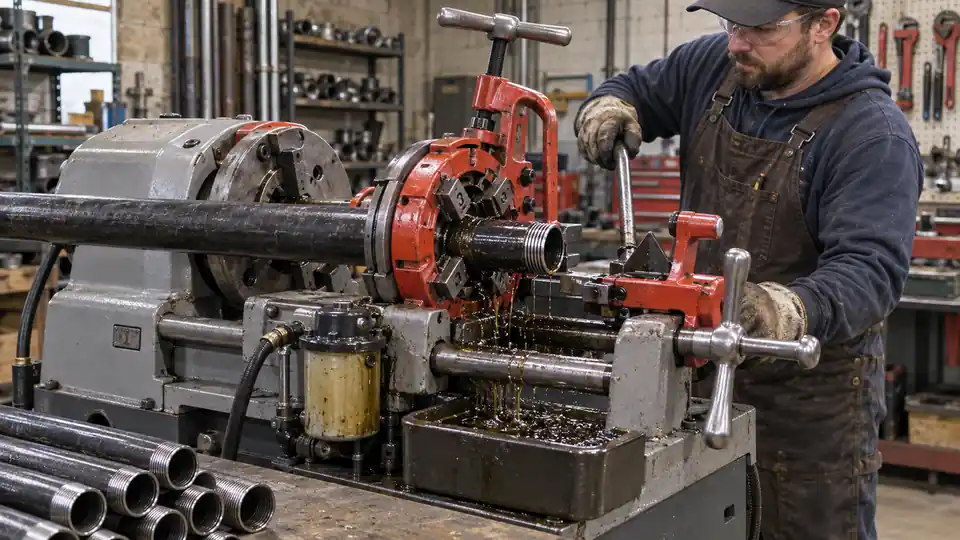
A pipe threading machine can turn a slow, tiring job into a repeatable process, but the right machine depends heavily on where and how you work. A handheld power drive may be ideal beside an existing pipe run, while a benchtop-style machine with a stand, cutter, reamer, and oiling system makes more sense for repeated fabrication in a shop or service vehicle. Pipe size, thread standard, portability, motor design, and included dies all affect the decision.
A common mistake is choosing by motor wattage alone. A high-wattage handheld unit may be convenient, yet it still requires careful pipe support and may be limited to NPT dies. A larger machine may offer better control and broader capacity, but its stand and heavier construction need more room. Buyers also have different priorities. A professional may value repeatable results and serviceability, while a homeowner may care more about portability and a complete set of dies. The RIDGID Model 300 is the strongest overall pick for demanding, repeated work, while the VEVOR handheld models offer more approachable options for occasional threading.
If you need a quick overview, the table below compares the nine strongest options by machine type, pipe range, and intended use.
Best Pipe Threading Machines Comparison Table
| Product | Best For | Type | Pipe Range |
|---|---|---|---|
| RIDGID 15682 Model 300 | Professional shop and field work | Complete stand-mounted machine | 1/2 to 2 inches |
| VEVOR 2300W Six-Die Threader | Portable general-purpose work | Handheld power drive | 1/2 to 2 inches |
| VEVOR 900W Four-Inch Machine | Larger pipe fabrication | Stand-mounted cutter and threader | 1/2 to 4 inches |
| VEVOR 2300W Four-Die Threader | Smaller pipe sizes and DIY jobs | Handheld power drive | 1/2 to 1 1/4 inches |
| VEVOR 750W 28RPM Machine | Routine 1/2 to 2-inch work | Stand-mounted cutter and threader | 1/2 to 2 inches |
| Holdwell S Six-Die Threader | Portable NPT threading | Handheld power drive | 1/2 to 2 inches |
| Hoteche 750W Heavy-Duty Machine | Automatic oiling and jobsite work | Stand-mounted machine | 1/2 to 2 inches |
| RIDGID 44923 Model 690-I | Professional handheld use | Handheld power drive | 1/2 to 2 inches |
| GZBEVITAR Electric Threader | Portable NPT work with HSS dies | Handheld power drive | 1/2 to 2 inches |
The detailed reviews explain where each machine fits, what its listed specifications mean in practice, and which limitations deserve attention before purchase.
Quick Answer
- Best overall: The RIDGID 15682 Model 300 offers the most complete setup for repeated professional threading, cutting, reaming, and related shop work.
- Best portable value: The VEVOR 2300W Six-Die Threader covers common 1/2 to 2-inch sizes in a handheld format.
- Best for larger pipe: The VEVOR 900W Four-Inch Machine extends the working range to 4 inches.
- Best for automatic oiling: The Hoteche 750W Heavy-Duty Machine includes an automatic oil pump for repeated threading work.
1. RIDGID 15682 Model 300 Power Drive Complete | Best Overall

The RIDGID Model 300 is the most complete match for buyers who need a dedicated pipe threading machine rather than a handheld drive alone. The package includes the power drive, stand with tray, carriage, reamer, cutter, die head, 1/2 to 2-inch alloy dies, and an oiler with a gallon of thread-cutting oil. That collection matters on a busy job because the machine arrives prepared for the basic sequence of securing, cutting, reaming, oiling, and threading pipe.
Its 38 RPM operating speed and reversible 1/2 HP universal motor are aimed at consistent work across common pipe sizes. The RIDGID speed chuck helps secure the workpiece, while the carriage moves along support bars instead of forcing the operator to hold the threading assembly by hand. Folding legs, transport wheels, and an integral locking tray make the setup more practical for service work, although this remains a substantial machine rather than a grab-and-go tool for a kitchen cabinet.
Pros
- Complete machine package with stand, cutter, reamer, dies, and oiler
- Includes alloy dies covering 1/2 to 2-inch pipe
- 38 RPM operation and reversible 1/2 HP motor
- Carriage and speed chuck support controlled threading
- Folding legs and transport wheels improve mobility
Cons
- Its complete stand-mounted format requires more storage space than handheld models
- The 2-inch maximum listed range is narrower than the four-inch VEVOR machine
This is the machine for a plumbing contractor, pipefitter, maintenance department, or serious workshop that expects regular threading rather than a single repair. It also makes sense for buyers who prefer a coordinated system instead of assembling a drive, dies, support, cutter, and reamer separately. A homeowner with only occasional small-diameter work may find the larger setup excessive, while a professional gains a more organized workflow and broader support than a handheld kit provides.
To buy this product, click here.
2. VEVOR 2300W Electric Pipe Threader With Six Dies | Best Portable Value
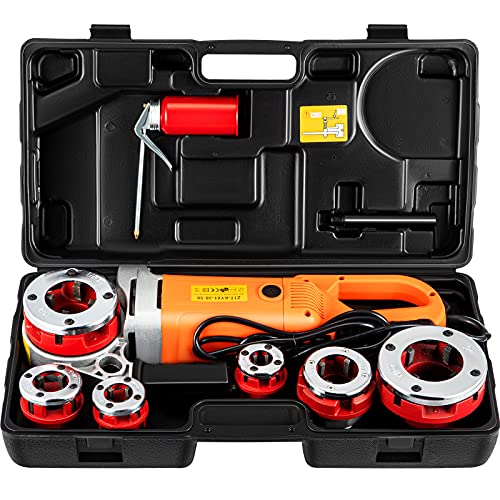
A handheld threader is useful when the pipe is already installed and taking it to a floor machine would be awkward. This VEVOR kit covers six common sizes from 1/2 to 2 inches and includes carbon steel dies, a fixed bar, pipe clamp, oil can, replacement carbon brushes, and a carrying case. The compact format suits repair work in basements, utility rooms, workshops, and construction areas where a wheeled stand would be inconvenient.
The listed 2300W copper-motor design runs at a stated no-load speed of 22 RPM. A forward and reverse switch helps with threading and die release, while the security button adds a useful layer of control during setup. The machine is described for galvanized, iron, and plastic pipe, but buyers should still match the die type and threading method to the pipe and fitting system specified for their job.
Pros
- Handheld format is easier to carry to installed pipe
- Six included dies cover 1/2 to 2 inches
- Includes clamp, fixed bar, oil can, and replacement brushes
- Forward and reverse controls simplify operation
- Carrying case keeps the kit together between jobs
Cons
- Handheld operation requires careful support and alignment of the pipe
- The 22 RPM listed speed is slower than several stand-mounted options here
This model fits a mobile repair technician or homeowner who needs broad size coverage without committing to a large machine. It is especially practical for threading short sections beside an existing line. Buyers producing many threaded lengths in a shop may prefer the carriage and work support of the RIDGID Model 300 or a stand-mounted VEVOR machine.
To buy this product, click here.
3. VEVOR 900W Two-Speed Pipe Threading Machine | Best for Larger Pipe

The defining feature here is its listed 1/2 to 4-inch working range. That gives this machine a different role from the many handheld 2-inch kits. A workshop handling larger steel pipe, automotive fabrication, or broader metalworking tasks may appreciate having the additional capacity available rather than stopping at the usual 2-inch ceiling.
This is a three-function machine for threading, deburring, and cutting, with a 900W motor and two listed speeds of 11 and 24 RPM. A foot pedal leaves both hands available for positioning and control, while the four-legged stand supports the work area. The included die sets cover 1/2 to 4 inches according to the supplied product information, making the package more flexible for mixed-size fabrication.
Pros
- Listed capacity extends from 1/2 to 4 inches
- Combines threading, deburring, and cutting
- Two speed settings support different pipe tasks
- Foot pedal allows hands-free motor control
- Four-legged stand provides a dedicated working platform
Cons
- Its larger capacity and stand format are unnecessary for buyers working only with small pipe
- The slower 11 RPM setting may make some operations take longer
Choose this machine when pipe size is the deciding factor. It is a better fit for a fabrication area that occasionally handles large pipe than a compact handheld kit can be. A buyer focused on routine 1/2 to 2-inch plumbing work may get a simpler setup from a smaller machine, while larger-pipe users gain valuable headroom.
To buy this product, click here.
4. VEVOR 2300W Electric Pipe Threader With Four Dies | Best for Smaller Pipe Sizes

This handheld VEVOR model focuses on the sizes many residential and light commercial projects use most often: 1/2, 3/4, 1, and 1 1/4 inches. The four included carbon steel dies keep the kit more focused than six-die models, which can be helpful if larger 1 1/2 and 2-inch pipe rarely appears on your project list.
The product listing specifies a 2300W copper-motor design, a 22 RPM no-load speed, forward and reverse switching, and a security button. A fixed bar, pipe clamp, oil can, and replacement brushes are included. Its portable body is easier to place beside an existing pipe run than a stand-mounted machine, but the operator must still keep the pipe stable and the die aligned throughout the cut.
Pros
- Targets common 1/2 to 1 1/4-inch pipe sizes
- Handheld design suits repair locations and small workspaces
- Includes four replaceable carbon steel dies
- Comes with a clamp, fixed bar, oil can, and spare brushes
- Forward and reverse controls aid die release
Cons
- Does not include the 1 1/2 and 2-inch dies supplied with broader kits
- Handheld work provides less built-in support than a floor machine
This is a sensible match for a homeowner, maintenance worker, or occasional plumber who knows the work will stay within its stated range. It avoids paying for unused larger dies while retaining powered operation. Choose a six-die alternative if your projects regularly move beyond 1 1/4 inches.
To buy this product, click here.
5. VEVOR 750W 28RPM Pipe Threading Machine | Best for Routine 1/2 to 2-Inch Work

The VEVOR 750W machine sits between a handheld kit and a heavier professional system. It covers 1/2 to 2-inch pipe and combines threading, reaming, and cutting in one stand-mounted unit. Its listed 28 RPM speed is quicker than the 22 RPM handheld VEVOR models, while the three-legged stand creates a dedicated base for repeated work.
A foot pedal frees the operator’s hands for pipe handling, and the included die sets cover 1/2 to 3/4 and 1 to 2 inches. The kit also includes an oil can, hex keys, screwdriver, storage bag, and support-leg screws. That makes it a practical choice for a workshop or service area where the machine can remain set up between jobs.
Pros
- Three-in-one design handles threading, reaming, and cutting
- 28 RPM listed operating speed suits repeated work
- Foot pedal supports hands-free motor control
- Includes dies for 1/2 to 2-inch pipe
- Stand-mounted format offers more support than a handheld drive
Cons
- Three-legged construction may offer less broad support than four-legged machines
- It lacks the larger 4-inch capacity of the VEVOR heavy-capacity model
This machine makes sense for a small plumbing shop or maintenance department that needs more structure than a handheld tool provides without moving to the full RIDGID package. It is also appealing for repeated fabrication of standard pipe sizes. Buyers who need automatic oil circulation should look closely at the Hoteche option instead.
To buy this product, click here.
6. Holdwell S 2300W Electric Pipe Threader | Best Portable NPT Kit

The Holdwell S is built around portable NPT threading from 1/2 to 2 inches. Its six listed dies are made from 9SiCr alloy steel, and the product information identifies them as NPT dies. That detail is central. Buyers working with BSPT or another thread standard should not assume these dies will substitute for the correct tooling.
The 2300W copper motor has a listed no-load speed of 26 RPM, placing it between the slower VEVOR handheld option and the faster stand-mounted machines in this group. The kit includes a pipe clamp, oil can, replacement brushes, safety lock, forward and reverse switch, and molded carrying case. The listed approximate weight of 29.5 pounds makes transport possible, though it is still substantial enough to deserve a secure work surface.
Pros
- Six dies cover 1/2 to 2-inch NPT threading
- Die material is listed as 9SiCr alloy steel
- 26 RPM listed no-load speed supports portable production work
- Includes pipe clamp, oil can, brushes, and carrying case
- Safety lock and forward/reverse controls support controlled operation
Cons
- Listed for NPT use and specifically identified as incompatible with BSPT
- Portable operation still requires careful external pipe support
This kit is a strong fit for contractors who frequently move between service locations and already know their fittings use NPT threads. Its explicit thread-standard limitation is helpful because it prevents an expensive compatibility mistake. Choose a stand-mounted machine for a fixed shop where speed, support, and repeated production matter more than portability.
To buy this product, click here.
7. Hoteche 750W Heavy-Duty Pipe Threading Machine | Best for Automatic Oiling

Threading produces friction, heat, and metal chips, so oil management becomes increasingly useful as the number of pipe sections rises. The Hoteche machine includes an automatic oil pump, oil bottle, and spray gun, giving it a more complete lubrication approach than handheld kits that rely on an oil can. The listed 750W motor runs at 28 RPM and covers 1/2 to 2-inch pipe.
The machine combines threading, cutting, and reaming, with a cutter wheel and pipe reamer built into the setup. Its four complete die sets are listed for standard sizes across the 1/2 to 2-inch range, and the three support legs provide a stable base. Reinforced plywood case packing is useful for protecting the machine during transport, though the stand-mounted design is still better suited to a shop, truck bay, or prepared jobsite than a cramped utility closet.
Pros
- Automatic oil pump supports continuous lubrication
- Combines threading, cutting, and reaming
- 28 RPM listed speed and 750W motor suit repeated standard-size work
- Includes dies covering 1/2 to 2-inch pipe
- Includes a cutter, reamer, oil accessories, and support legs
Cons
- Three-leg stand requires a suitable level work area
- Its NPT-oriented setup may not suit projects using another thread standard
This machine is worth a close look for plumbing, HVAC, fire-sprinkler, and conduit work where multiple pipe sections need cutting, reaming, oiling, and threading in sequence. It offers a useful middle ground between a handheld drive and the more comprehensive RIDGID system. Buyers with occasional repairs may find the automatic oiling hardware more than they need.
To buy this product, click here.
8. RIDGID 44923 Model 690-I Hand-Held Power Drive Kit | Best Professional Handheld Option

The Model 690-I takes a different approach from the Model 300. It provides professional handheld power drive equipment with 1/2 to 2-inch 11-R NPT die heads and a carrying case, making it better suited to threading pipe that cannot conveniently be removed or transported to a floor machine. A contoured grip and over-molded handle are useful details for jobs that involve repeated repositioning.
Its quick-release die-head retaining system reduces the fuss involved in changing heads, while the dual V-jaw support arm helps hold the workpiece during operation. Screw-in brush covers also make access for maintenance more straightforward. The kit is still dependent on correct pipe support and alignment, but its design is aimed at tradespeople who need a durable portable drive rather than a complete stand-mounted fabrication station.
Pros
- Professional handheld format suits installed pipe
- Includes 1/2 to 2-inch 11-R NPT die heads
- Quick-release system simplifies die-head changes
- Dual V-jaw support arm helps stabilize the workpiece
- Carrying case and accessible brush covers support field service
Cons
- Its listed 11-R NPT die heads are not a universal thread-standard solution
- It does not provide the integrated cutter, reamer, and stand found with larger machines
This is the portable pick for a professional who values RIDGID’s established power-drive format and needs to work around existing pipe. It is more specialized than a general-purpose stand machine, yet that specialization is useful on service calls and retrofit work. A workshop producing many loose pipe sections will likely prefer a machine with its own carriage and work platform.
To buy this product, click here.
9. GZBEVITAR Upgraded 2300W Electric Pipe Threader | Best for HSS Dies

The GZBEVITAR handheld threader distinguishes itself with listed high-speed steel dies and an aluminum alloy die head. The six sizes run from 1/2 to 2 inches, and the product information lists compatibility with galvanized, iron, stainless steel, and other pipe materials. That broad material description still calls for careful matching between the pipe, die, cutting oil, and fitting thread standard.
A wide clamp and thickened support bar are intended to reduce movement while threading, while the 26 RPM listed speed places it in the same general portable performance class as the Holdwell. The kit includes an oil can, storage box, six brushes, and two snap rings. A power indicator light, rubber handle, and ventilation openings add practical touches for a portable tool that may move between a workshop and a renovation site.
Pros
- Includes six listed HSS dies from 1/2 to 2 inches
- Aluminum alloy die head is lighter than a comparable steel head
- Wide clamp and thickened support bar aid workpiece stability
- 26 RPM listed speed supports portable threading tasks
- Includes storage box, oil can, brushes, and snap rings
Cons
- Handheld design still needs a firm support arrangement for accurate threads
- The listing does not provide the integrated cutting and reaming workflow of stand-mounted machines
This model is a reasonable fit for buyers who place particular value on the listed HSS die material and portable storage. It can cover common pipe sizes without the footprint of a floor machine. A buyer focused on high-volume fabrication, automatic lubrication, or a built-in cutter should move up to one of the stand-mounted options.
To buy this product, click here.
How to Choose a Pipe Threading Machine
Start With the Pipe Size
Check the nominal pipe sizes you actually need to thread. Most portable kits in this roundup stop at 2 inches, while the VEVOR four-inch machine is intended for a broader range. A machine that covers 1/2 to 2 inches is not automatically suitable for 2 1/2, 3, or 4-inch work, so the die range should be confirmed before purchase.
Choose Handheld or Stand-Mounted
Handheld threaders are useful beside installed pipe, in cramped spaces, and on mobile service calls. They depend more heavily on the included support bar, clamp, and the operator’s setup. Stand-mounted machines take more room, but they give the pipe and threading head a more structured working relationship. That difference becomes noticeable when producing several threaded sections in a row.
Check the Thread Standard
Thread size and thread standard are separate details. Several products here list NPT dies, while the RIDGID 690-I specifically lists 11-R NPT die heads. The Holdwell listing states that its dies are for NPT and are not compatible with BSPT. Confirm the thread standard required by the fittings and system before ordering replacement dies or a complete machine.
Look at the Complete Workflow
Threading is only one part of preparing pipe. Cutting leaves an end that may need reaming, and threading generally requires suitable cutting oil. Stand-mounted machines such as the RIDGID Model 300, VEVOR 750W, Hoteche, and VEVOR four-inch model include various combinations of cutters, reamers, oiling equipment, and stands. A handheld kit may be the better tool for a single installed connection, while a complete machine saves repeated setup time in a workshop.
Match Motor and Speed to the Work
Wattage is a motor input specification, not a complete measure of threading performance. The listed machines vary in motor power and rotational speed, and their mechanical support systems differ too. A lower-wattage stand-mounted machine can still be more suitable for repeated fabrication than a high-wattage handheld tool because the workpiece is supported differently. Treat speed, control, cooling, dies, and work support as a package.
Plan for Oil, Chips, and Maintenance
Pipe threading is messy. Provide a stable work surface, use the correct cutting oil, clear chips safely, and follow the manufacturer’s maintenance instructions. Replacement brushes, die heads, and compatible cutting components may matter more over time than a small difference in listed motor numbers. Automatic oiling, as found on the Hoteche, can be useful for repeated work, while an oil can may be perfectly adequate for occasional repairs.
Best Pipe Threading Machines FAQ
What is the best pipe threading machine for professional work?
The RIDGID 15682 Model 300 is the strongest overall selection here for repeated professional work because it includes a stand, carriage, cutter, reamer, die head, 1/2 to 2-inch dies, and an oiler. Its complete layout is better suited to a prepared shop or jobsite than occasional household repairs.
Are handheld pipe threaders suitable for installed pipe?
Yes. Handheld models are specifically useful when a pipe section cannot easily be removed or carried to a floor machine. They still require firm support, correct alignment, suitable oil, and the correct die standard. The RIDGID 690-I and the handheld VEVOR, Holdwell, and GZBEVITAR kits serve this type of work.
What pipe sizes do these machines support?
Most of the selected machines cover 1/2 to 2-inch pipe. The VEVOR 2300W four-die model stops at 1 1/4 inches, while the VEVOR 900W machine is listed for 1/2 to 4 inches. Check the included die sizes rather than relying on the general product name.
Are NPT and BSPT dies interchangeable?
No. NPT and BSPT are different thread standards. A product listing that identifies NPT dies should not be treated as support for BSPT. Confirm the fitting and pipe requirements before selecting a machine or replacement die set.
Do all pipe threading machines cut and ream pipe?
No. Stand-mounted models such as the RIDGID Model 300, VEVOR 750W, Hoteche, and VEVOR four-inch machine list cutting and reaming functions or accessories. Handheld power-drive kits are primarily focused on driving die heads and may require separate tools for cutting and deburring.
Is a higher wattage always better?
No. Wattage alone does not describe the entire threading system. Pipe support, die quality, speed, motor control, oiling, and the intended workload all matter. A stand-mounted machine with a lower listed wattage may be more convenient for repeated fabrication than a handheld machine with a higher number.
What maintenance does a pipe threader need?
Follow the product’s maintenance instructions, keep dies clean, use appropriate cutting oil, remove chips, inspect clamps and support components, and replace brushes or worn dies as specified. A machine should be disconnected from power before maintenance, and any electrical work should follow the manufacturer’s instructions and applicable local requirements.
Should a homeowner buy a full-size pipe threading machine?
Only if the homeowner expects repeated threading work or needs the machine for a workshop. For one or two repairs, a portable handheld kit may take less storage space and cover the required sizes. A full-size machine becomes more practical when cutting, reaming, oiling, and threading are repeated across many pipe sections.
Final Verdict
The RIDGID 15682 Model 300 is the best overall pipe threading machine in this group because it represents the core professional use case clearly. It combines a 38 RPM power drive with a stand, carriage, cutter, reamer, oiler, and alloy dies covering 1/2 to 2 inches. That complete workflow makes it the most compelling option for contractors, maintenance teams, and workshops that expect regular threading rather than an occasional repair.
For portable work, the VEVOR 2300W six-die threader offers broad 1/2 to 2-inch coverage in a handheld kit, while the RIDGID 44923 Model 690-I is the more professional handheld alternative for buyers who specifically need its 11-R NPT die-head setup. If larger pipe is central to the job, the VEVOR 900W machine reaches 4 inches. Before choosing, verify the nominal pipe sizes, thread standard, pipe material, available workspace, and need for cutting or reaming. The best machine is the one that matches the actual pipe and workflow waiting in front of you.
