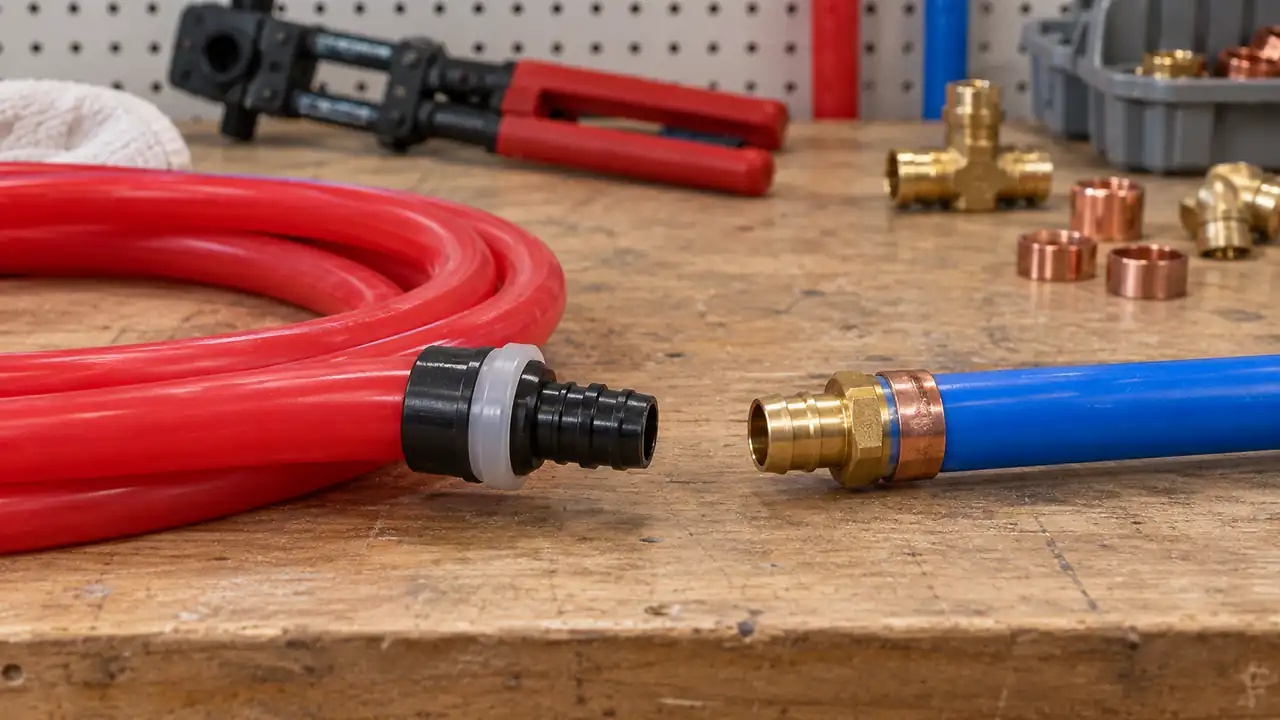
PEX A and PEX B are both cross-linked polyethylene tubing, but they are manufactured differently and behave differently during installation. PEX A is generally more flexible and is commonly used with expansion-style connections. PEX B is usually stiffer, often costs less, and is widely installed with crimp or clamp connections.
Neither type is automatically the right choice for every project. The better option depends on the layout, connection system, available tools, fitting supply, local requirements, and the manufacturer’s instructions.
PEX A vs. PEX B at a Glance
| Feature | PEX A | PEX B |
|---|---|---|
| Manufacturing process | Commonly produced with a peroxide-based method | Commonly produced with a moisture-cure silane method |
| Flexibility | Generally more flexible | Generally stiffer |
| Typical connection options | Expansion, crimp, clamp, and other approved systems | Crimp, clamp, and other approved systems, depending on the tubing and fitting |
| Kink behavior | Often easier to bend and may recover better from a minor kink when the product instructions allow repair | May retain a kink more readily and commonly requires a fitting or a cutout section for repair |
| Tool requirements | Expansion tools for expansion connections, or different tools for crimp and clamp systems | Crimp tools, clamp tools, or another tool specified for the selected connection method |
| Typical cost pattern | Often higher for tubing and expansion components | Often lower, although prices vary by brand, size, and fitting system |
| Best-known advantage | Flexibility and compatibility with expansion connections | Availability, stiffness for straight runs, and broad use with crimp or clamp systems |
How PEX A and PEX B Are Made
The letters describe the manufacturing method, not a quality grade. PEX A, PEX B, and PEX C are all forms of cross-linked polyethylene, but their production processes create different handling characteristics.
PEX A is commonly manufactured with a peroxide-based process. This method generally produces tubing with greater flexibility and elasticity. PEX B is commonly manufactured with a moisture-cure silane process. It generally produces tubing with a firmer feel and more resistance to bending by hand.
The designation does not mean that PEX A is always better than PEX B. Tubing quality, wall thickness, pressure and temperature ratings, fitting design, installation technique, and system compatibility all affect the finished installation.
Flexibility and Installation Differences
PEX A is easier to bend around obstacles
PEX A usually bends more easily around framing, corners, and other obstacles. Its flexibility can reduce the number of fittings needed in a layout, provided the bend radius and support requirements are followed. Fewer joints may simplify the installation and reduce the number of potential connection points.
PEX A can still kink if it is bent too sharply or forced into a tight space. A kinked section should be handled according to the tubing manufacturer’s instructions. Some PEX A products allow a minor kink to be corrected with controlled heat from an approved method. A severely damaged section may require cutting out and replacing.
PEX B works well for straighter runs
PEX B is usually stiffer, which can make long, straight runs easier to align and support. That same stiffness may make it less convenient in tight framing cavities or around multiple corners. Careful planning helps prevent excessive force and sharp bends.
A kink in PEX B commonly requires a repair fitting or replacement of the damaged section. Do not try to restore a kink by crushing, stretching, heating, or repeatedly bending the tubing unless the product instructions specifically allow that procedure.
Connection Methods Are Separate From PEX Type
PEX type and connection method are related, but they are not the same classification. PEX A is not limited to expansion connections, and PEX B is not limited to crimp connections.
Depending on the product and fitting system, either tubing type may be used with crimp, clamp, push-to-connect, or another approved connection method. Expansion connections are most commonly associated with PEX A because that tubing is generally more elastic. Some PEX B products may be approved for particular expansion systems, but the tubing, fitting, and tool must be specified for that use.
Common connection systems include:
- Crimp connections: A copper or stainless-steel ring is compressed around an insert fitting with a compatible crimp tool.
- Clamp connections: A stainless-steel clamp is tightened around the tubing and fitting with the matching clamp tool.
- Expansion connections: The tubing is expanded with a compatible tool, then placed over a fitting designed for that system. The tubing contracts around the fitting.
- Push-to-connect connections: The tubing enters a fitting that uses an internal sealing and gripping mechanism. Compatibility with the exact tubing and fitting must be confirmed.
A crimp tool does not make a clamp connection, and an expansion tool does not make every PEX connection. Select the tool for the connection method, tubing, and fitting system rather than relying on the appearance of the parts.
Fittings, Flow, and Compatibility
Expansion fittings often use a larger internal passage than insert fittings used with some crimp and clamp systems. That can reduce the restriction at the individual fitting. The effect on a complete plumbing system depends on tubing size, run length, total fittings, valves, pressure, and fixture demand.
PEX B used with crimp or clamp fittings can still provide suitable flow for residential plumbing when the system is properly sized. A larger fitting passage alone does not determine whether a layout will deliver adequate flow.
Check these details before combining components:
- The tubing type and product designation
- The nominal tubing size
- The fitting connection system
- The tool required for that connection
- The fitting manufacturer’s compatibility information
- The intended use, such as potable water, hydronic heating, or another application
A label such as “1/2-inch” identifies a nominal tubing or fitting size. It does not mean that every 1/2-inch component uses the same connection system or has the same internal passage. Match the actual tubing and fitting system before assembly.
Cost and Tool Requirements
PEX B is often selected for projects where crimp or clamp equipment is already available. Tubing and fittings may be less expensive than comparable PEX A expansion components, although prices vary by supplier and product line.
PEX A expansion connections require an expansion tool that matches the fitting system. Manual and powered tools may be available, but the correct tool depends on the manufacturer’s specifications. PEX A can also be used with crimp or clamp connections where the tubing and fittings are approved for that method.
The lowest tubing price does not necessarily produce the lowest project cost. Account for:
- Connection tools
- Fittings and support hardware
- Repair couplings
- Availability of replacement parts
- Access to the work area
- The number of bends and connections in the layout
Freeze Behavior and Durability
PEX can expand more than some rigid piping materials when water inside the tubing freezes. That characteristic may reduce the chance of an immediate split, but PEX is not freeze-proof. Connections, valves, manifolds, and attached fixtures can still be damaged by freezing conditions.
PEX A is generally more elastic than PEX B, so it may tolerate certain freeze-expansion events better. This does not make it a substitute for insulation, heat, drainage, or proper winterization. Repeated freezing can damage tubing or connections of either type.
Both types should be protected from prolonged ultraviolet exposure. Store and install the tubing according to the product instructions, especially in areas exposed to sunlight or outdoor conditions.
PEX A or PEX B: Which Should You Choose?
PEX A may suit the project if:
- The layout has many bends or limited access.
- You want to use an approved expansion connection system.
- Greater tubing flexibility would simplify routing.
- The selected fittings and expansion tools are readily available.
- Repair procedures for the specific tubing are understood before installation.
PEX B may suit the project if:
- The layout consists mainly of straight runs.
- Crimp or clamp connections fit the planned installation.
- You want a firmer tube that is easier to position along a straight route.
- The local supplier carries compatible tubing, fittings, and repair parts.
- Keeping material and tool costs controlled is a priority.
For a small repair, matching the existing connection system may matter more than choosing between PEX A and PEX B. Mixing tubing types within a plumbing system can be acceptable in some applications, but each joint still needs compatible fittings and the correct installation method. Do not assume that a fitting designed for one PEX system works with another because the tubing has the same nominal size.
What Matters More Than the Letter
The PEX designation is only one part of the selection decision. A well-installed system depends on tubing approved for the application, correctly sized runs, compatible fittings, proper support, protection from physical damage, and connections made with the specified tools.
For potable water, heating systems, concealed piping, or unusual temperatures and pressures, verify the product’s intended application and installation requirements. Local plumbing requirements may also affect the permitted materials and connection methods.
PEX A is generally the more flexible option and offers a natural fit for expansion connections. PEX B is generally stiffer, widely available, and commonly paired with crimp or clamp systems. Choosing between them becomes more straightforward after the layout, connection method, tool access, and compatible components have been identified.
