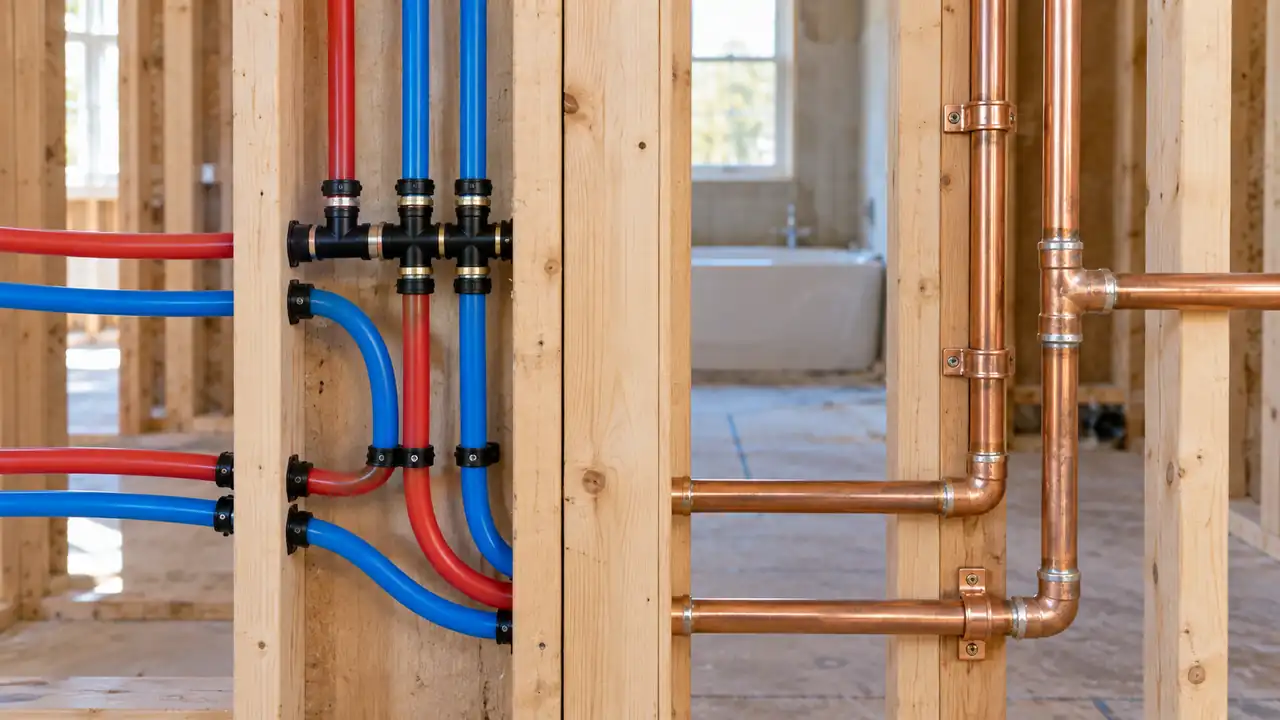
PEX and copper can both carry water through a residential supply system, but they solve installation problems differently. PEX is flexible plastic tubing that can run around obstacles with fewer directional fittings. Copper is rigid metal pipe that holds a straight, exposed layout and can be joined by soldering, pressing, or other compatible methods. For most projects, the better choice depends on where the pipe will run, how it will be protected, and what the local requirements allow.
PEX vs. copper at a glance
| Decision factor | PEX | Copper |
|---|---|---|
| Routing | Flexible enough for gradual bends and long runs | Rigid; changes in direction generally require fittings |
| Connections | Uses a compatible crimp, clamp, expansion, push-to-connect, or other specified system | Common methods include soldered, press, and compression connections |
| Light exposure | Must be protected from sunlight and other UV exposure according to product instructions | Suitable for many exposed locations, subject to protection from physical damage and local requirements |
| Water chemistry | Does not corrode like metal pipe, though tubing and fittings still have application limits | Can corrode under unfavorable water conditions |
| Freezing | May tolerate some expansion, but tubing and fittings can still fail | Can split if water freezes inside it |
| Cost | Often less expensive to route through finished spaces | Material and labor costs are often higher, especially for runs with many turns |
Installation and repair differences
PEX can be routed through framing with broad bends, reducing the number of elbows in some layouts. That flexibility is particularly useful in a repipe where access is limited. It does not eliminate the need for proper support, protection where tubing passes through framing, or attention to bend limits. A kink, an unsupported run, or tubing placed against a sharp edge can create problems regardless of how few fittings are used.
Copper generally takes more cutting and fitting to route around obstacles, but its rigidity helps produce orderly exposed runs. Joining methods have different tool and preparation requirements. Soldering involves heat near the work area; press connections require compatible fittings and a press tool. A repair decision may therefore depend as much on access and available equipment as on pipe material.
PEX type and joining method are separate choices. PEX A, PEX B, and PEX C describe tubing made by different processes; they do not, by themselves, tell you which fitting or tool to use. Confirm that the tubing, fittings, rings or sleeves, and tool are specified to work together. Likewise, a fitting marked with the same nominal size as an existing pipe is not automatically a suitable transition between materials.
Performance in a finished plumbing system
Flow and sizing
Neither material guarantees better water flow on its own. The pipe’s inside diameter, run length, number and type of fittings, and simultaneous fixture demand all affect delivery. Some PEX fittings extend into the tubing and reduce the opening through the joint, while a layout with fewer elbows may offset some of that restriction. A poorly sized run can limit flow regardless of material.
Commonly used nominal copper and PEX tubing sizes can share outside-diameter conventions, but their wall thicknesses and inside diameters may differ. For a new layout or substantial repipe, size the lines for the fixtures they serve rather than assuming the old pipe’s nominal size is always the right replacement.
Heat, exposure, and water conditions
Both materials must be selected for the system’s water temperature and pressure. PEX also needs protection from UV exposure and must be kept clear of heat sources or locations that exceed the tubing manufacturer’s limits. Copper is useful where pipe will remain visible or where a rigid run is desirable, provided the location and water conditions are suitable.
Copper’s corrosion risk varies with water chemistry and installation conditions. PEX tubing avoids metal-pipe corrosion, but that does not make every fitting immune to water-related damage. If an existing copper system has repeated pinhole leaks, replacing individual sections without investigating the cause may leave the broader problem unresolved.
Freezing and service life
Neither PEX nor copper is freeze-proof. PEX has some ability to expand, but frozen water can damage its fittings and tubing. Pipe placement, insulation where appropriate, and protection of vulnerable spaces matter more than relying on either material to survive a freeze.
Both materials can serve for many years when suited to the water and installed correctly. A universal service-life figure would overlook water chemistry, temperature, pressure, exposure, fitting quality, and installation conditions.
Which material fits the project?
- Consider PEX for a repipe through walls and floors. Its flexibility can simplify routing and reduce the number of concealed directional fittings. Verify the tubing’s intended application and protect it from damage and UV exposure.
- Consider copper for exposed, straight runs. It holds its shape without the same routing flexibility as PEX, which can make an accessible mechanical-room layout easier to keep orderly.
- Evaluate an existing system before replacing it. Sound copper does not need replacement solely because PEX is available. Repeated leaks, poor access, or a larger renovation may change the calculation.
- Compare installed costs, not tubing prices alone. Fittings, tools, access, wall repairs, and labor can outweigh the difference in pipe price.
A house can also use both materials. A compatible, accessible transition may let new PEX serve an added fixture while existing copper remains in service. Follow the transition fitting’s instructions and applicable local plumbing requirements. If replacing metal pipe could interrupt an electrical bonding path, have that condition evaluated rather than assuming the new plastic run can serve the same electrical function.
