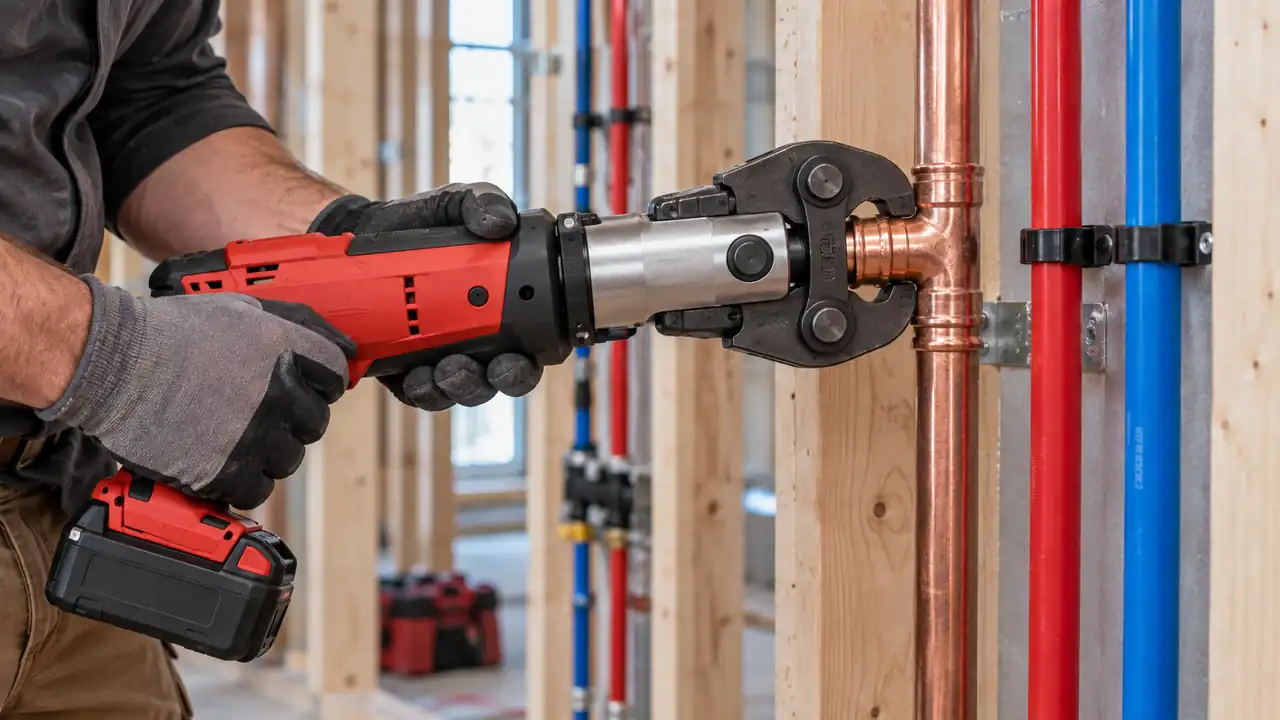
A copper fitting tucked behind a water heater can turn a routine repair into a cramped, awkward wrestling match. A cordless press tool changes that scene completely. Instead of heating a joint or fighting with a bulky hand crimper, you position the correct jaw, start the cycle, and move on to the next connection. The catch is that plumbing press tools vary sharply in pipe range, jaw compatibility, pressing force, battery system, and intended workload.
The most common buying mistake is treating every tool labeled “ProPress compatible” as interchangeable. A tool may support only specific compact jaws, while another may include dies for copper, ASTM F1807 PEX rings, and ASTM F877 stainless sleeves. Pipe size matters too. A compact tool suited to 1/2-inch and 3/4-inch residential work may be a poor fit for larger copper installations. After comparing the available specifications, the RIDGID RP 251 is the strongest overall choice for buyers who want a compact professional tool with broad material support, while several lower-cost kits make more sense for occasional work or mixed copper and PEX projects.
Short on time? The comparison below puts the nine leading options side by side so you can quickly match a tool to your pipe sizes, materials, and workload.
Best Plumbing Press Tools Comparison Table
| Product | Best For | Tool Type | Supported Work |
|---|---|---|---|
| RIDGID RP 251 Compact Press Tool | Professional versatility | Cordless electric | Copper, stainless steel, PEX, carbon steel |
| 18V Pro Press Tool Kit | Best value | Cordless electric | Copper and PEX systems |
| Growlush 18V Cordless Pro Press Tool | Tight work areas | Cordless electric | Copper and PEX systems |
| ROGVOC Copper Press Tool | Residential copper work | Cordless electric | 1/2-inch to 1-inch copper |
| VEVOR 32KN Press Tool | Larger copper pipe | Cordless electric | 1/2-inch to 2-inch copper |
| RIDGID RP 115 Mini Press Tool | Compact professional work | Mini cordless electric | 1/2-inch and 3/4-inch copper |
| VEVOR 24KN Press Tool | Common copper repairs | Cordless electric | 1/2-inch to 1-inch copper |
| VEVOR 24KN VUS Press Tool Kit | Portable copper installation | Cordless electric | 1/2-inch to 1-inch copper |
| Growlush Copper Pipe Press Tool | Low-cost occasional use | Manual hydraulic | Copper and PEX systems |
The detailed reviews explain how the tools differ in jaw systems, materials, workspace access, and expected workload.
Quick Answer
- Best Overall: RIDGID RP 251 Compact Press Tool for professionals who need one compact tool covering several pipe materials.
- Best Value: 18V Pro Press Tool Kit for buyers who need copper and multiple PEX connection systems in one kit.
- Best for Larger Copper: VEVOR 32KN Press Tool because its included jaws extend through 2-inch copper.
- Best Compact Option: RIDGID RP 115 Mini Press Tool for frequent 1/2-inch and 3/4-inch work in tight residential spaces.
1. RIDGID 78148 RP 251 Compact Press Tool Battery Kit Best Overall
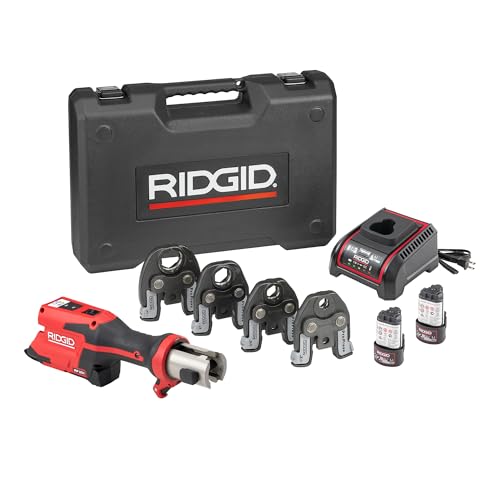
The RP 251 is the most broadly capable tool in this group for a plumber who handles varied service calls. Its compact in-line design supports copper and stainless steel connections up to 1-1/4 inches, PEX tubing up to 1-1/2 inches, and carbon steel up to 1 inch, according to the supplied listing. That range matters on a busy day when one job involves a copper repair and the next involves PEX or carbon steel. You are less likely to reach for a second press platform simply because the material changed.
Its forward trigger and SlimGrip handle are shaped for one-handed operation, which is useful above a ceiling, beside a vanity, or inside a crowded mechanical closet. The 360-degree head swivel helps with alignment, while the LED lights address the shadowy corners where plumbing work often happens. The 12V battery is smaller than the packs used by several competing kits, yet the listing states up to 140 presses per charge and a brushless motor rated for more than 60,000 press cycles. Bluetooth connectivity also provides tool information through the RIDGID Link app, a practical touch for crews tracking service intervals.
Pros
- Supports copper, stainless steel, PEX, and carbon steel applications.
- Compact in-line form supports one-handed operation.
- 360-degree head swivel improves access around obstacles.
- LED work lights help in dark cabinets and overhead spaces.
- Bluetooth access provides cycle, battery, and service information.
Cons
- The included compact jaws do not cover every pipe size listed for the tool.
- Its professional feature set may be more than an occasional homeowner needs.
Choose the RP 251 if dependable access, material flexibility, and long-term service tracking matter more than a low entry cost. It is especially well suited to contractors who move between repair, remodel, and light commercial work. A homeowner handling one copper fitting may find the investment excessive, while a full-time user gains a much more adaptable platform than the narrow copper-only kits.
To buy this product, click here.
2. 18V Pro Press Tool for Copper and PEX Pipes Best Value

This kit makes a persuasive case for buyers who need more than a copper-only press tool. It includes dies for 1/2-inch, 3/4-inch, and 1-inch copper, five ASTM F1807 PEX copper ring sizes from 3/8-inch through 1 inch, and three ASTM F877 stainless PEX sleeve sizes from 1/2-inch through 1 inch. That collection gives a remodeler room to work across common residential systems without purchasing separate manual tools for each connection method.
The 18V brushless motor is listed with a roughly three-second press cycle, and the kit includes two 4.0Ah batteries. The key detail is that the dies with matching size markings are not interchangeable across copper, F1807, and F877 systems. A 1/2-inch die for one system is not automatically the correct die for another. That requires careful setup, yet the clearly separated system coverage is also the kit’s biggest advantage. A plumber repairing a kitchen branch line in the morning and assembling PEX runs during a remodel can keep both batteries and all 11 dies in the supplied case.
Pros
- Supports copper, ASTM F1807 PEX, and ASTM F877 stainless sleeves.
- Includes 11 dies covering common residential sizes.
- Two 4.0Ah batteries support extended cordless work.
- Brushless motor is listed with a fast three-second press cycle.
- Carrying case keeps the tool, dies, batteries, and charger together.
Cons
- Users must match each die to the correct connection system, not only the pipe size.
- The broad die assortment can take more time to organize than a copper-only kit.
This is the value pick for serious DIY remodelers, maintenance workers, and smaller plumbing crews that need copper and PEX flexibility. It makes less sense for someone who works exclusively with one copper fitting size, since several dies may remain unused. Verify the fitting standard before every press, and the kit offers unusually broad coverage for its category.
To buy this product, click here.
3. Growlush 18V Cordless Pro Press Tool Best for Tight Spaces

A bathroom cabinet rarely offers a straight, comfortable approach to a fitting. The Growlush kit addresses that sort of frustration with a slim head that rotates up to 350 degrees. That movement can help when a supply line, stud, or nearby fitting blocks the ideal angle. Its included set covers 1/2-inch, 3/4-inch, and 1-inch copper; ASTM F1807 PEX copper rings from 3/8-inch through 1 inch; and ASTM F877 stainless sleeves from 1/2-inch through 1 inch.
The listing describes an 18V hydraulic tool with two 4.0Ah batteries and 80KN of force. It also lists reinforced jaws and a construction target of more than 10,000 cycles. Those figures make the tool relevant to users who want powered pressing with a broad die selection, though cycle claims should still be read as manufacturer specifications rather than a guarantee of service life in every environment. Picture a basement repair where the fitting sits behind a water heater. The rotating head and cordless format may save awkward repositioning, while the full die set reduces the need to carry multiple tools.
Pros
- 350-degree slim-head rotation suits awkward corners and narrow work areas.
- Includes dies for copper and two common PEX connection systems.
- Two 4.0Ah batteries support longer work sessions.
- 80KN listed pressing force gives the tool a substantial operating margin on paper.
- Reinforced jaws and hydraulic construction suit repeated project use.
Cons
- Users must verify the fitting standard before selecting one of the similarly sized dies.
- The broad hydraulic body may still require more clearance than a mini professional tool.
Pick this Growlush model for mixed-material residential work where access is the daily headache. Its strongest argument is positioning flexibility, not the simple number printed on the force specification. Buyers who mostly press straight runs in open framing can save space and complexity with a narrower kit.
To buy this product, click here.
4. ROGVOC Copper Press Tool Best for Residential Copper Work

The ROGVOC takes a more focused approach than the mixed copper and PEX kits. Its three VUS jaws cover 1/2-inch, 3/4-inch, and 1-inch copper pipe, the sizes commonly encountered around water heaters, kitchens, bathrooms, and residential remodels. An 18V brushless motor supplies the hydraulic action, and the kit includes two batteries, a charger, and a carrying case. That is a sensible configuration for someone who wants a cordless copper press tool without sorting through a large collection of connection-specific PEX dies.
The compact body and non-slip grip are useful in the moments that make a copper repair tiring: reaching under a sink, working beside a furnace, or holding the tool at shoulder height. The supplied information describes support for residential, HVAC, and construction work, though it does not provide a larger jaw range or mixed-material compatibility. That limitation is easy to understand. A focused kit can feel quicker to set up because the correct jaw is easier to identify, but it is less adaptable if the job shifts from copper to PEX.
Pros
- Focused 1/2-inch, 3/4-inch, and 1-inch copper coverage.
- 18V brushless motor provides cordless hydraulic pressing.
- Includes three VUS jaws, two batteries, charger, and case.
- Non-slip grip supports control during awkward copper repairs.
- Compact form is suited to residential and HVAC work areas.
Cons
- Its included jaw set is narrower than the mixed-material kits in this roundup.
- The supplied information does not indicate support for PEX or stainless sleeve systems.
This model fits a buyer who knows the work will center on copper and wants a straightforward kit. It is a better match for repeated residential copper repairs than for a remodel involving several PEX connection standards. Check that your fittings are compatible with the included VUS jaws before starting, particularly if your existing press platform uses a different jaw family.
To buy this product, click here.
5. VEVOR 18V Electric Pipe Crimping Tool Best for Larger Copper Pipe

Most compact residential press kits stop at 1 inch. This VEVOR model reaches farther, with six listed VUS jaws covering 1/2-inch, 3/4-inch, 1 inch, 1-1/4 inches, 1-1/2 inches, and 2-inch copper tubes. That expanded range gives it a clear role for larger copper installation and repair, where a small residential kit simply cannot accept the required jaw. The 32KN specification and brushless 18V motor are aimed at efficient powered pressing across that range.
The tool also includes two 4.0Ah batteries, a fast charger, a 360-degree rotating head, and a carrying case. The listing states up to 350 crimps per charge, though real output depends on pipe size, fitting resistance, battery condition, and working conditions. A contractor moving between larger mechanical-room connections may appreciate the extra jaw coverage and battery capacity. A homeowner repairing a 1/2-inch line may find the larger kit more cumbersome than necessary, especially if the added sizes never leave the case.
Pros
- Includes six jaws covering copper sizes from 1/2 inch through 2 inches.
- 32KN listed crimping force supports larger copper applications.
- Two 4.0Ah batteries are suited to extended installation sessions.
- 360-degree rotating head improves access around piping obstacles.
- Carrying case simplifies transport and jaw storage.
Cons
- The tool is specialized for copper and does not include the mixed-material dies found in some kits.
- Its expanded size range adds bulk for buyers handling only small residential pipe.
Choose this VEVOR when 1-1/4-inch, 1-1/2-inch, or 2-inch copper is part of the actual job list. Its distinction is useful capacity rather than general-purpose versatility. If your work stays below 1 inch, one of the smaller 24KN kits or the compact RIDGID options may be easier to carry and position.
To buy this product, click here.
6. RIDGID 72553 RP 115 Mini Press Tool Best Compact Professional Option

The RP 115 is built around a narrow job profile, and that is exactly why it can be appealing. It includes 1/2-inch and 3/4-inch ProPress jaws, the sizes that appear frequently in residential repairs, and its mini hydraulic format is intended to reduce the struggle of overhead or confined work. A 210-degree swivel head gives the user room to approach a fitting from a more useful angle, while one-handed jaw opening keeps the other hand available for positioning the pipe.
The SlimGrip handle and optimized trigger further support control in tight spaces. This is the tool you might reach for beneath a kitchen sink or behind a finished wall access panel, where a larger press body can bump surrounding surfaces. Its limitation is equally clear: the included jaws cover only two copper sizes, and the supplied listing does not present it as a broad PEX or larger-pipe platform. A compact tool is helpful only when its narrower capacity matches the work.
Pros
- Mini format is well suited to tight residential spaces.
- Includes 1/2-inch and 3/4-inch ProPress jaws.
- 210-degree swivel head improves approach angles.
- One-handed jaw operation helps during careful pipe alignment.
- SlimGrip handle and trigger support controlled overhead work.
Cons
- The included jaws do not cover 1-inch copper or larger pipe.
- Its narrow application range is less suitable for mixed-material or broad commercial work.
The RP 115 suits a professional who repeatedly handles small copper connections and values access over range. It can also appeal to a homeowner with several planned 1/2-inch or 3/4-inch repairs, provided the cost of a professional mini tool fits the project. Skip it for large copper, PEX systems, or jobs that require frequent jaw changes across several sizes.
To buy this product, click here.
7. VEVOR 18V Electric Pipe Crimping Tool Best for Common Copper Repairs

This VEVOR kit focuses on the three copper sizes most likely to matter in ordinary residential installation: 1/2 inch, 3/4 inch, and 1 inch. Its 24KN electric pressing system, 360-degree rotating crimp head, two 18V 2.0Ah batteries, charger, and case create a practical package for repairs where a manual tool would make every connection feel like a workout. The rotating head is particularly useful beside walls, inside cabinets, and around existing pipe layouts.
The listing states up to 200 crimps per charge and a pressing speed advantage over slower methods, though job conditions influence actual output. Its key compatibility boundary deserves attention. The tool is intended for 24KN compact press jaws, and additional jaws may be required for other pipe types or connection systems. That makes it less of a universal press platform than the mixed-material kits, but the simpler copper focus can be an advantage if copper is all you install. A small service van can keep the case organized without carrying a full assortment of PEX dies.
Pros
- Includes 1/2-inch, 3/4-inch, and 1-inch copper jaws.
- 360-degree rotating head supports awkward pipe approaches.
- Two 18V 2.0Ah batteries provide cordless flexibility.
- 24KN pressing force suits common compact copper applications.
- Carrying case keeps the core kit together for service calls.
Cons
- Compatibility is limited to the specified 24KN compact jaw family.
- The included batteries have less stated capacity than the 4.0Ah packs in several competing kits.
This is a sensible match for a repair technician or homeowner who mainly works with small copper and wants powered pressing without a large professional platform. It is less suitable for PEX-heavy remodels or larger copper systems. Confirm the fitting and jaw requirements before purchase, since “compatible with ProPress” does not mean every ProPress jaw will fit this tool.
To buy this product, click here.
8. VEVOR 18V Press Tool Kit with VUS Jaws Best Portable Copper Kit

This VEVOR kit covers the same familiar copper sizes as many residential press tools, with VUS jaws for 1/2 inch, 3/4 inch, and 1 inch. Its defining difference is the 180-degree rotating head paired with a slim body. That combination may be useful in a utility closet or under a sink where the fitting is visible but the approach is blocked by framing. The two 2.0Ah batteries and fast charger keep the package portable without relying on a cord.
The 24KN platform is intended for compact 24KN press jaws, and the listing specifically states that additional jaws are needed for other pipe types. That distinction puts this model firmly in the copper repair and installation lane. A homeowner replacing several copper sections may appreciate the included case and straightforward three-jaw setup. A contractor who changes between copper, PEX rings, and stainless sleeves will likely prefer a kit with those dies included from the start.
Pros
- Includes VUS jaws for 1/2-inch, 3/4-inch, and 1-inch copper.
- 180-degree head rotation helps in confined layouts.
- Slim body is convenient for transport and smaller work areas.
- Two 18V 2.0Ah batteries support cordless repairs.
- Case, charger, and jaws are packaged as a portable kit.
Cons
- Its 180-degree head offers less rotation than the 360-degree options here.
- It is limited to the specified 24KN compact jaw system and listed copper focus.
Select this model for portability and straightforward copper work rather than broad system compatibility. It is a useful middle ground for occasional contractors and capable DIY users who want an electric tool in the truck or workshop. Buyers planning a mixed PEX and copper project should compare the complete die lists carefully before settling on it.
To buy this product, click here.
9. Growlush Copper Pipe Press Tool with 11 Dies Best Manual Budget Option

Powered tools are fast, but they are not the only way to make a press connection. This manual hydraulic Growlush tool includes 11 dies for 1/2-inch, 3/4-inch, and 1-inch copper; ASTM F1807 PEX copper rings from 3/8-inch through 1 inch; and ASTM F877 stainless sleeves from 1/2-inch through 1 inch. That makes it one of the broadest low-cost choices here for a buyer who can accept hand pumping and a slower work rhythm.
The slim head rotates through 360 degrees, and the supplied information lists an 80KN output, an approximately 15.7-inch tool length, and a construction target above 10,000 cycles. The listing also says the fitting must be at least 1.5 inches from the wall and warns against using the tool without a die installed. Those setup details matter in a cramped bathroom. A manual tool can be perfectly practical for a single repair, yet repeated overhead connections may make a cordless model much more comfortable.
Pros
- Includes 11 dies for copper and two PEX connection systems.
- 360-degree slim-head rotation supports varied positioning.
- Manual operation avoids battery charging and motor maintenance.
- Non-slip handle supports one-person operation.
- Listed 80KN output provides substantial hydraulic force on paper.
Cons
- Manual pumping is slower and more tiring for large batches of connections.
- The listing specifies clearance and die-installation requirements that limit some cramped installations.
This is the budget-minded pick for occasional repairs, emergency preparedness, or a DIY remodel where the tool may spend long periods in a cabinet. It can also serve as a backup when a battery is empty. Choose a powered model instead if you regularly make dozens of connections, work overhead, or need the quicker cycle and easier repetition of an electric press platform.
To buy this product, click here.
Buying Guide for Best Plumbing Press Tools
Match the Tool to the Connection System
A press tool, a PEX crimp tool, and a PEX clamp tool are different systems. The products in this roundup include copper press jaws, ASTM F1807 copper-ring dies, and ASTM F877 stainless-sleeve dies. Those systems should not be treated as interchangeable. Read the fitting manufacturer’s instructions, identify the connection standard, and select the die marked for that system and pipe size.
Check Jaw Compatibility Carefully
“ProPress compatible” describes a useful relationship, but it does not guarantee that every jaw family fits every tool. Several VEVOR listings here use specified 24KN or 32KN compact jaw platforms, while other products use VUS or RIDGID compact jaws. Confirm the tool’s supported jaw type before buying extra dies. A jaw that fits physically may still be incorrect for the fitting system.
Choose the Right Size Range
For many residential copper repairs, 1/2 inch, 3/4 inch, and 1 inch cover the most common needs represented by these listings. Larger work changes the decision. The VEVOR 32KN model includes jaws through 2 inches, while the RIDGID RP 251 has separate listed limits for copper, stainless steel, PEX, and carbon steel. Do not select a larger tool merely because the number looks impressive. Select it because the pipe sizes and materials are part of your actual work.
Decide Between Cordless and Manual Operation
Cordless electric tools reduce repetitive hand effort and speed up a long sequence of connections, but they require batteries and a compatible charger. A manual hydraulic tool avoids battery management and can be a reasonable backup or occasional-use solution. For a one-off bathroom repair, manual operation may be perfectly adequate. For a full remodel or daily service work, powered pressing is usually easier to sustain.
Think About Access Before Force
Pressing force matters, yet head movement and tool shape often determine whether you can reach the fitting at all. Rotating heads help around studs, cabinets, and existing pipe. Mini tools such as the RIDGID RP 115 focus on small copper sizes and tight access, while larger kits trade some compactness for a wider capacity range. Measure the working space around the fitting, not simply the pipe itself.
Review the Complete Kit
Compare the included jaws, batteries, charger, and case rather than looking at the tool body alone. A kit with two batteries can keep work moving while one pack charges. A kit with 11 dies may cover several connection standards, but it also requires more careful organization. If you already own compatible jaws or batteries, check whether the new tool works with them before assuming the kit contents are interchangeable.
Best Plumbing Press Tools FAQ
What Is a Plumbing Press Tool Used For?
A plumbing press tool uses a compatible jaw or die to form a mechanical connection around a properly prepared fitting. The products here are primarily listed for copper, stainless steel, PEX, or carbon steel applications, depending on the model. The pipe, fitting, and jaw system must all match before pressing.
Are All ProPress-Compatible Tools Interchangeable?
No. Compatibility depends on the tool’s jaw platform, pressing force, fitting system, and supported pipe sizes. A listing may support compact ProPress-style jaws while excluding other jaw families. Check the exact tool and fitting instructions rather than relying on the general phrase “ProPress compatible.”
Can These Tools Press PEX?
Some can, but the connection method matters. The 18V Pro Press kit, Growlush 18V model, and manual Growlush tool list dies for ASTM F1807 PEX copper rings and ASTM F877 stainless sleeves. The copper-focused VEVOR and ROGVOC kits should not be assumed to support PEX unless the listing specifically identifies the required dies.
What Pipe Sizes Are Most Common for Residential Press Work?
The products in this selection commonly cover 1/2-inch, 3/4-inch, and 1-inch copper. Those sizes appear throughout the residential kits, while the VEVOR 32KN model extends its included copper jaws through 2 inches. Confirm the fitting’s nominal size and the die marking before pressing.
Is a Manual Hydraulic Press Tool Worth Buying?
A manual tool can make sense for occasional repairs, backup use, or a project where battery-powered equipment is unnecessary. It generally requires more hand effort and takes longer across many connections. A cordless tool is more convenient for repeated work, while a manual model can be economical when the tool will be used only a few times.
Why Does the Press Head Rotate?
A rotating head lets the user align the jaw with a fitting when nearby walls, cabinets, studs, or existing pipe prevent a straight approach. The listed rotation varies by product, including 180, 210, 350, and 360 degrees. More rotation can improve positioning, but it does not replace the need for adequate clearance around the fitting.
Do Press Tools Need Different Jaws for Different Materials?
Usually, yes. Copper press fittings, ASTM F1807 PEX rings, and ASTM F877 stainless sleeves may require different dies even when the pipe sizes match. A 1/2-inch marking alone is not enough to identify the correct die. Follow the fitting manufacturer’s instructions and confirm the die system before starting the press cycle.
Should Homeowners Use These Tools for Every Plumbing Repair?
They can be useful for compatible repair work, but the tool does not eliminate preparation or compatibility checks. The pipe must be cut and prepared correctly, the fitting must be seated fully, and the correct die must complete the cycle. Larger or regulated plumbing modifications may require a licensed professional, permits, or inspection under local requirements.
Final Verdict
The RIDGID RP 251 is the strongest overall pick because it represents the core professional use of a plumbing press tool while covering several materials and offering compact one-handed operation. Its 360-degree head, LED lighting, Bluetooth tool information, and listed support for copper, stainless steel, PEX, and carbon steel give it a broader working role than the copper-only kits. It is a substantial investment, so the advantage becomes clearer for contractors and frequent service users than for someone making one repair under a sink.
For a lower-cost route into powered pressing, the 18V Pro Press Tool Kit is the most versatile alternative among the value-oriented models, provided you carefully match its 11 dies to the correct connection standard. The VEVOR 32KN model is the better fit for larger copper through 2 inches, while the RIDGID RP 115 makes sense for compact professional work limited to 1/2-inch and 3/4-inch copper. Before ordering any of these nine tools, write down your pipe materials, nominal sizes, fitting system, available clearance, and expected workload. That short checklist will matter more than a flashy force number or an oversized accessory bundle.
