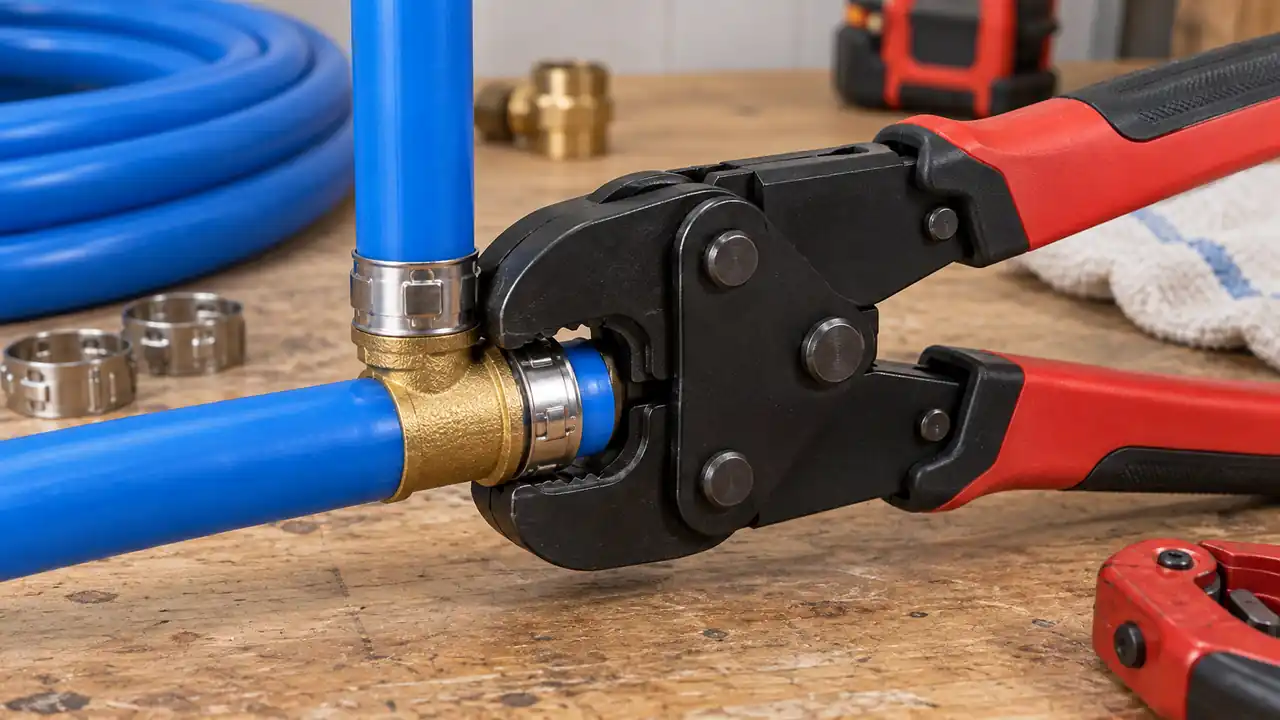
A PEX press tool can turn a long afternoon of tightening, checking, and rechecking connections into a much quicker installation, but the wrong tool can create a compatibility headache before the first pipe is cut. Buyers are choosing among manual hydraulic crimpers, cordless press tools, and compact systems that work with specific PEX ring standards. The key is matching the tool and die to the connection method, pipe size, and fitting system you actually plan to use.
The common mistake is treating every PEX tool as interchangeable. ASTM F1807 copper-ring tools, ASTM F877 stainless-sleeve tools, and clamp systems use different connection hardware, so a die marked with the right nominal size may still be the wrong die for the fitting. Battery capacity, head rotation, included jaws, workspace clearance, and workload matter too. A homeowner repairing a few lines may prefer a manual hydraulic tool, while a contractor handling repeated connections may value a cordless press cycle and spare battery. Among these options, the Growlush 18V Cordless Pro Press Tool offers the broadest mix of die coverage, cordless mobility, and tight-space access.
For a quick side-by-side look, the table below highlights the main differences before the detailed reviews.
Best PEX Press Tools Comparison Table
| Product | Best For | Tool Type | Supported Systems and Sizes |
|---|---|---|---|
| Growlush 18V Cordless Pro Press Tool | Best Overall | Cordless hydraulic | Copper 1/2 to 1 inch, F1807 3/8 to 1 inch, F877 1/2 to 1 inch |
| Pipe Press Tool with 11 Dies | Manual hydraulic value | Hand-operated hydraulic | Copper 1/2 to 1 inch, F1807 3/8 to 1 inch, F877 1/2 to 1 inch |
| Growlush Copper Pipe Press Tool | DIY plumbing projects | Hand-operated hydraulic | Copper 1/2 to 1 inch, F1807 3/8 to 1 inch, F877 1/2 to 1 inch |
| 18V Pro Press Tool CZ-1930 | Fast repeated pressing | Cordless brushless | Copper 1/2 to 1 inch, F1807 3/8 to 1 inch, F877 1/2 to 1 inch |
| AMZCNC 18V Press Tool | Professional jobsite work | Cordless hydraulic | Copper 1/2 to 1 inch, F1807 3/8 to 1 inch |
| VEVOR Cordless Mini Press Tool | Compact F1807 installations | Cordless electric | F1807 copper rings, 1/2, 3/4, and 1 inch |
| VEVOR Copper Pipe Crimping Tool | Manual copper and PEX work | Hand-operated hydraulic | Copper 1/2 to 1 inch, F1807 3/8 to 1 inch |
| HZLZRZ 21V Brushless Pro Press Tool | Longer cordless work sessions | Cordless brushless | Copper 1/2 to 1 inch, F1807 3/8 to 1 inch, F877 1/2 to 1 inch |
| ketailei Pro Press Tool | High-force cordless pressing | Cordless hydraulic | Copper 1/2 to 1 inch, F1807 3/8 to 1 inch, F877 1/2 to 1 inch |
The reviews below look more closely at die coverage, operating style, workspace access, and the tradeoffs that separate these tools.
1. Growlush 18V Cordless Pro Press Tool — Best Overall

The Growlush 18V cordless tool is the most balanced pick for buyers who want one kit to cover several common PEX and copper connection systems. Its 11 dies include jaws for 1/2, 3/4, and 1-inch copper pipe, ASTM F1807 copper rings from 3/8 to 1 inch, and ASTM F877 stainless sleeves from 1/2 to 1 inch. That range matters in a remodel where one bathroom may use 1/2-inch PEX while a larger supply run calls for 3/4-inch material.
The 350-degree rotating slim head is particularly useful around vanity cabinets, basement framing, and crowded mechanical spaces. A cordless hydraulic tool also avoids dragging a long handle through a rough-in area. The kit includes two 4.0Ah batteries and a charger, so a second battery can remain ready while the first is working. Its listed 80KN output and heavy-duty construction suggest a tool aimed at repeated use, though buyers should still follow the fitting maker’s pressing procedure and confirm that the selected die matches the fitting standard.
Pros
- Includes 11 dies for copper, ASTM F1807, and ASTM F877 systems.
- Two 4.0Ah batteries support cordless work with less interruption.
- 350-degree rotating head helps with angled and confined installations.
- Listed 80KN hydraulic output suits demanding press connections.
- Includes sizes commonly used in residential and commercial plumbing.
Cons
- The broad die set requires careful matching because same-size dies are intended for different fitting systems.
- The cordless body may be more tool than needed for a few occasional connections.
This is the strongest fit for a plumber, remodeler, or serious DIY user who wants wide compatibility without carrying separate tools for each connection type. It also makes sense for overhead or cramped work where a manual handle would be awkward. Buyers who use one PEX system and make only a handful of repairs may save space with a simpler manual tool instead.
To buy this product, click here.
2. Pipe Press Tool with 11 Dies — Best Manual Value

A manual hydraulic press can be a sensible pick for a homeowner who wants broad die coverage without maintaining batteries or charging equipment. This kit includes 11 interchangeable dies for 1/2, 3/4, and 1-inch copper pipe, F1807 copper rings from 3/8 to 1 inch, and F877 stainless sleeves from 1/2 to 1 inch. That is unusually wide coverage for a hand-operated format, especially for a renovation involving both copper and PEX.
The 360-degree slim head gives the tool plenty of positioning flexibility around tees, cabinets, and framing. Its non-slip handle is intended to make the hydraulic pumping motion easier to manage, though manual pressing still requires more physical effort than the cordless models. The steel construction and listed 10,000-plus-cycle design claim point toward repeated use, but the real practical advantage is simplicity. There is no motor or battery system to troubleshoot, so it can sit in a plumbing case until the next repair.
Pros
- 11 included dies cover three major fitting categories.
- 360-degree head rotation helps align the tool in tight locations.
- Manual operation avoids batteries, chargers, and motor maintenance.
- Supports F1807 sizes from 3/8 to 1 inch.
- Ergonomic handle is intended to reduce hand fatigue during pumping.
Cons
- Manual hydraulic operation takes more time and effort for large installation runs.
- Users must leave enough clearance for the tool and handle movement around the fitting.
This model suits homeowners, maintenance workers, and occasional installers who value a wide range of dies and straightforward storage. It is especially practical for a repair kit that may be used months apart. A contractor pressing dozens of fittings in a day will likely prefer a powered tool for faster cycles and less repetitive pumping.
To buy this product, click here.
3. Growlush Copper Pipe Press Tool — Best for DIY Plumbing Projects

This Growlush manual tool gives DIY buyers the same broad connection coverage as several more expensive-looking cordless kits, but its hand-powered design keeps the operating system simple. The 11-die set handles copper pipe from 1/2 to 1 inch, F1807 copper rings from 3/8 to 1 inch, and F877 stainless sleeves from 1/2 to 1 inch. That makes it useful for a homeowner replacing a few fittings, extending a water line, or working through a small remodel.
The listed tool length is approximately 15.7 inches, and the manufacturer states that the fitting should be at least 1.5 inches from the wall. Those clearance details are easy to overlook when a fitting sits behind a cabinet or close to framing. The 360-degree head helps with orientation, but it cannot eliminate the need for working room. The tool is listed with 80KN output and a 10,000-plus-cycle construction claim, giving it a more substantial profile than a light repair-only crimper.
Pros
- Broad 11-die coverage includes copper, F1807, and F877 connections.
- 360-degree rotating head supports awkward approach angles.
- Manual design is independent of batteries and charging equipment.
- Listed 80KN output provides substantial hydraulic pressing force.
- Clearance guidance helps beginners plan fitting placement.
Cons
- Its approximately 15.7-inch length may be cumbersome inside very tight cabinets.
- Manual pumping is less convenient for high-volume installations than cordless pressing.
This is a reasonable match for a capable DIYer who wants one versatile tool and is willing to work carefully through the connection sequence. It is also a useful backup for a professional who wants a non-battery option in the truck. Skip it for repeated overhead work or production-style installation where a powered cycle would reduce fatigue.
To buy this product, click here.
4. 18V Pro Press Tool CZ-1930 — Best for Fast Repeated Pressing

The CZ-1930 is aimed at buyers who want a cordless workflow across copper and two PEX press systems. Its 11 dies cover 1/2, 3/4, and 1-inch copper, F1807 copper rings from 3/8 to 1 inch, and F877 stainless sleeves from 1/2 to 1 inch. The listing describes a brushless 18V motor and a press cycle that can finish in about three seconds, which is useful during a long run where manual pumping would become tedious.
The two 4.0Ah batteries are a practical part of the package rather than a minor accessory. A plumber can keep one charging while using the other, and the carrying case keeps the tool, dies, batteries, and charger together. Die selection deserves attention because the same size marking does not mean that a copper, F1807, and F877 die are interchangeable. The tool is most useful for buyers who already understand the fitting system or are prepared to follow the fitting manufacturer’s instructions closely.
Pros
- Brushless 18V motor supports fast cordless pressing.
- Two 4.0Ah batteries reduce charging interruptions.
- 11 dies cover copper, F1807, and F877 applications.
- Carrying case keeps the complete kit organized for transport.
- Useful for residential, commercial, and remodeling work.
Cons
- The large assortment can create die-selection mistakes for inexperienced users.
- A powered press tool requires battery storage and charging space.
Choose this model for installation days that involve many connections and frequent movement between work areas. It offers a strong blend of speed and system coverage without restricting the buyer to one PEX connection style. A homeowner making one or two connections may find the cordless equipment unnecessary compared with a manual hydraulic kit.
To buy this product, click here.
5. AMZCNC 18V Press Tool — Best for Professional Jobsite Work

The AMZCNC focuses on the workflow details that matter during a busy plumbing job. Its automatic hydraulic cycle is listed at about three seconds, and the slim head is intended for corners, utility rooms, ceilings, and other areas where a larger tool can become awkward. The 11 included dies cover 1/2, 3/4, and 1-inch copper pipe plus F1807 PEX fittings from 3/8 to 1 inch.
The listing also says each tool is tested before shipment, including the hydraulic pressure, battery, charger, and pressing cycle. That statement does not replace checking the tool when it arrives, but it gives professional buyers a clear reason to look at this model for jobsite use. The straight ergonomic handle and dual rechargeable batteries support a repeatable routine: select the correct die, seat the fitting, complete the cycle, and move to the next connection.
Pros
- Automatic hydraulic cycle is listed at approximately three seconds.
- Slim head is suited to corners and overhead installations.
- Includes 11 interchangeable dies for common copper and F1807 sizes.
- Dual batteries support continued cordless work.
- Listing specifies factory testing of the tool and charging components.
Cons
- The supplied die coverage listed here does not include F877 stainless sleeves.
- Professional-oriented features may exceed the needs of occasional repair work.
This tool fits contractors and installers whose work centers on copper press fittings and ASTM F1807 PEX. It is a better match for a defined system than for a buyer who frequently switches among every available sleeve type. Check the fitting inventory before purchase, especially if stainless F877 sleeves are part of the planned project.
To buy this product, click here.
6. VEVOR Cordless Mini Press Tool — Best Compact Option for F1807 Rings

The VEVOR cordless mini tool takes a narrower approach than the full multi-system kits. It is built around ASTM F1807 PEX copper-ring connections in 1/2, 3/4, and 1-inch sizes, with two press jaws and a 1-inch dovetail die seat. That focused format can be easier to manage for a homeowner or installer whose plumbing project uses F1807 rings throughout.
A 180-degree rotating head and slim body help the tool reach confined areas, while the brushless motor provides listed 24KN pressing force. Two 2.0Ah batteries and a fast charger support mobile work, and the carrying case keeps the compact tool protected between repairs. The limitation is equally clear: buyers who need copper pipe press dies, F877 sleeves, or smaller 3/8-inch F1807 rings will need a different kit or additional compatible jaws.
Pros
- Compact cordless design is suited to tight working areas.
- Supports 1/2, 3/4, and 1-inch F1807 copper rings.
- 180-degree rotating head improves access around obstructions.
- Brushless motor provides listed 24KN pressing force.
- Includes two batteries, a charger, and a carrying case.
Cons
- Its included system coverage is narrower than the 11-die tools.
- The listed jaws do not cover every common PEX size or fitting method.
This is the pick for someone who wants a compact electric tool for a clearly defined F1807 project. A kitchen or bathroom rough-in using 1/2 and 3/4-inch copper rings may be a natural fit. Buyers working across copper press fittings, stainless sleeves, and several PEX standards should choose a broader kit instead of relying on separately purchased jaws.
To buy this product, click here.
7. VEVOR Copper Pipe Crimping Tool — Best Manual Copper and PEX Option

This VEVOR hydraulic tool is a practical middle ground for buyers who want manual operation with coverage for copper and ASTM F1807 copper rings. Its eight dies include 1/2, 3/4, and 1-inch copper jaws plus F1807 sizes from 3/8 to 1 inch. That makes it relevant for repairs and remodels that use both copper press fittings and PEX copper-ring connections, without adding the F877 sleeve dies found in the broader kits.
The head rotates through 360 degrees, a useful detail when a fitting sits behind a tee or near a framing member. Aluminum-alloy jaws are listed for the tool, and the hydraulic mechanism is intended to apply even pressure through a hand-pumped operation. It has the familiar rhythm of manual plumbing tools: cut and prepare the pipe, position the fitting, select the matching die, then press. That pace is slower than cordless work but avoids battery downtime.
Pros
- Eight dies cover common copper and F1807 sizes.
- 360-degree head rotation helps with complex angles.
- Manual hydraulic operation avoids battery charging.
- Includes the smaller 3/8-inch F1807 size.
- Ergonomic handle supports controlled hand operation.
Cons
- Does not include listed F877 stainless-sleeve dies.
- Manual pumping is less efficient for a large number of connections.
Choose this tool if your project uses copper press fittings and F1807 rings and you prefer a straightforward hand-operated kit. It can be a sensible addition to a home workshop where occasional use matters more than rapid cycle time. Look elsewhere if your fittings use stainless F877 sleeves or if you regularly press connections across multiple floors.
To buy this product, click here.
8. HZLZRZ 21V Brushless Pro Press Tool — Best for Extended Cordless Work
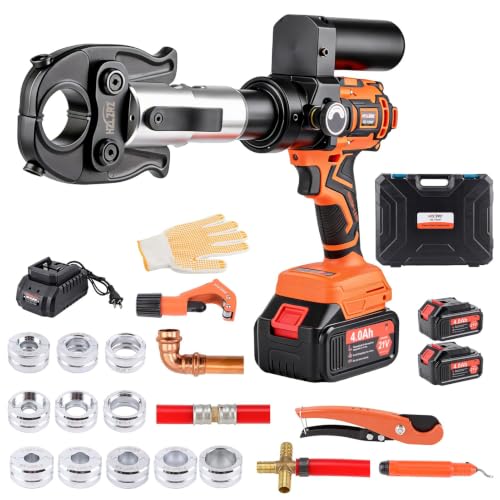
The HZLZRZ kit targets plumbers and serious DIY users who want a complete cordless package for common copper and PEX work. It includes 1/2, 3/4, and 1-inch copper dies, F1807 dies from 3/8 to 1 inch, and F877 stainless-sleeve dies from 1/2 to 1 inch. That makes the set useful for jobs where the connection method may change from one section of a project to another.
The listing describes a brushless motor, a press cycle of about three seconds, two 4.0Ah batteries, and a fast charger. The second battery is especially useful on a long installation because the tool can remain mobile while the spare charges. A carrying case also helps prevent small dies from disappearing into a crowded truck drawer. Like the other multi-system tools, this model rewards careful identification of the fitting before pressing, since a same-size die from the wrong system is still unsuitable.
Pros
- Includes copper, F1807, and F877 die sets.
- Two 4.0Ah batteries support longer cordless work.
- Brushless motor is listed for fast pressing.
- 11 dies cover common residential and commercial sizes.
- Carrying case simplifies transport and storage.
Cons
- The large kit requires organized die storage and careful system identification.
- Its cordless format may be excessive for isolated repairs.
This tool is best suited to buyers who want broad system coverage and expect to work away from a power outlet for extended periods. It gives contractors a complete mobile setup and gives serious remodelers room to handle several fitting types. A single-system user may prefer the smaller VEVOR mini tool or a manual kit with fewer components.
To buy this product, click here.
9. ketailei Pro Press Tool — Best High-Force Cordless Option

The ketailei cordless press tool is built around an 18V MAX hydraulic system listed at 12 tons, with a pressing cycle of about three seconds. Its die assortment covers 1/2, 3/4, and 1-inch copper, F877 stainless sleeves in the same three sizes, and F1807 copper rings from 3/8 to 1 inch. That combination gives it the range needed for a mixed-system plumbing project without requiring a separate manual crimper.
The cordless format is useful in crawl spaces, ceilings, and remote work areas where a long manual handle can be awkward. The listing describes a lightweight portable design and a rugged hard case, although it does not provide detailed weight information for comparison. Factory testing is also listed as part of the product description. Buyers should treat the force rating as a stated specification rather than a reason to skip proper pipe preparation, fitting insertion, and die selection.
Pros
- Listed 12-ton hydraulic system supports high-force pressing.
- Three-second cycle is suited to repeated connections.
- Includes dies for copper, F1807, and F877 systems.
- Cordless design works in ceilings, crawl spaces, and remote areas.
- Rugged carrying case supports storage and transport.
Cons
- Its higher-force positioning may be unnecessary for small homeowner repairs.
- The listing provides less detail about the included battery capacity than several competing kits.
This model makes sense for a buyer who places a high value on cordless hydraulic force and broad die coverage. It is a useful alternative to the Growlush overall pick for someone focused on the stated 12-ton system. Buyers who want clearly specified spare-battery capacity may prefer one of the kits that lists two 4.0Ah batteries.
To buy this product, click here.
How to Choose the Best PEX Press Tool
Match the Connection System
Start with the fitting, not the tool. ASTM F1807 uses copper crimp rings, while ASTM F877 uses stainless PEX press sleeves. Copper press fittings are another category listed by several tools here. A die marked “1/2 inch” is not automatically suitable for every 1/2-inch connection. Confirm the fitting standard and use the die intended for that system.
Check Supported Sizes
Most residential PEX work centers on 1/2 and 3/4-inch pipe, but 3/8-inch and 1-inch sizes can matter in specialty layouts or larger supply runs. A kit covering 3/8 to 1 inch offers more flexibility, while a compact tool limited to 1/2, 3/4, and 1 inch may be easier to carry. Compare the actual die list with the materials on your project before ordering.
Choose Manual or Cordless Operation
Manual hydraulic tools avoid batteries and can remain ready for occasional repairs. They also require pumping and enough handle clearance. Cordless tools press faster and reduce repetitive effort, which is valuable across a large rough-in, but they add batteries, a charger, and more equipment to maintain.
Measure the Workspace
A rotating head helps, but it does not make every tool suitable for a crowded cabinet. Check the room around the fitting, the distance from the wall, and the direction from which the tool must approach. Slim-head cordless models can be useful in corners, while longer manual tools may need more open access.
Review the Complete Kit
Look for the number and type of dies, battery count, charger, carrying case, and any stated operating accessories. Two kits may both list 11 dies while serving different fitting systems. Keep the dies labeled and separated by connection type so a copper die is not confused with an F1807 or F877 die.
Follow the Fitting Manufacturer’s Procedure
Proper results depend on more than hydraulic force. Cut the pipe cleanly, insert the fitting fully, position the ring or sleeve correctly, and complete the press cycle according to the fitting instructions. Check local plumbing requirements for the installation, especially for work that requires permits or inspection.
Best PEX Press Tools FAQ
Are PEX press tools and PEX crimp tools the same?
No. The terms can describe different connection systems. PEX crimp tools commonly work with copper rings, while press tools may also refer to stainless sleeves or copper press fittings. Check the fitting standard and the die supplied for that standard.
Can one die work with every 1/2-inch PEX fitting?
No. A 1/2-inch die for an ASTM F1807 copper ring should not be treated as interchangeable with a die for an ASTM F877 stainless sleeve or a copper press fitting. Size and connection system both matter.
Is a cordless PEX press tool better than a manual hydraulic tool?
It depends on the workload. Cordless tools are faster and reduce hand pumping during repeated connections. Manual hydraulic tools avoid battery management and can be a practical choice for occasional repairs or small projects.
What sizes should a general-purpose PEX press tool support?
A broad kit may include 3/8, 1/2, 5/8, 3/4, and 1-inch F1807 dies, plus 1/2, 3/4, and 1-inch dies for other supported systems. Your own pipe and fitting sizes should determine the final choice.
Can these tools be used in tight spaces?
Several models have rotating slim heads intended for corners, cabinets, basements, and overhead work. Space is still required around the fitting and tool body, so measure the installation area before choosing a manual or cordless format.
Do all of these tools work with stainless PEX sleeves?
No. The Growlush 18V, the CZ-1930, the HZLZRZ, and the ketailei kits list ASTM F877 stainless-sleeve dies. The VEVOR mini tool is centered on F1807 copper rings, while some manual options list copper and F1807 coverage without F877 dies.
Does more pressing force guarantee a better connection?
No. The die must match the fitting, the pipe must be cut and inserted correctly, and the press cycle must follow the fitting instructions. A higher force rating does not make an incompatible die suitable.
Should a homeowner buy a kit with every available die?
Only if the project uses several supported systems or future work justifies the extra equipment. A focused tool can be easier to organize, while a broad kit reduces the need to buy another tool later. Compatibility should guide the decision.
Final Verdict
The Growlush 18V Cordless Pro Press Tool is the strongest overall choice in this group because it combines cordless operation, two 4.0Ah batteries, a 350-degree slim head, and 11 dies covering copper, ASTM F1807, and ASTM F877 systems. That broad coverage suits remodelers and plumbers who may encounter different connection types across one job. The CZ-1930 and HZLZRZ are close alternatives for buyers who place extra emphasis on fast cordless pressing and extended battery-supported work.
For occasional repairs, the manual Pipe Press Tool with 11 Dies or the Growlush Copper Pipe Press Tool avoids battery management while retaining broad die coverage. The VEVOR Cordless Mini Press Tool is the more focused compact pick for F1807 copper rings in common sizes, while the ketailei model appeals to buyers drawn to its listed high-force hydraulic system. Before purchasing, match the die list to your fittings, check access around each connection, and follow the fitting manufacturer’s installation procedure.
