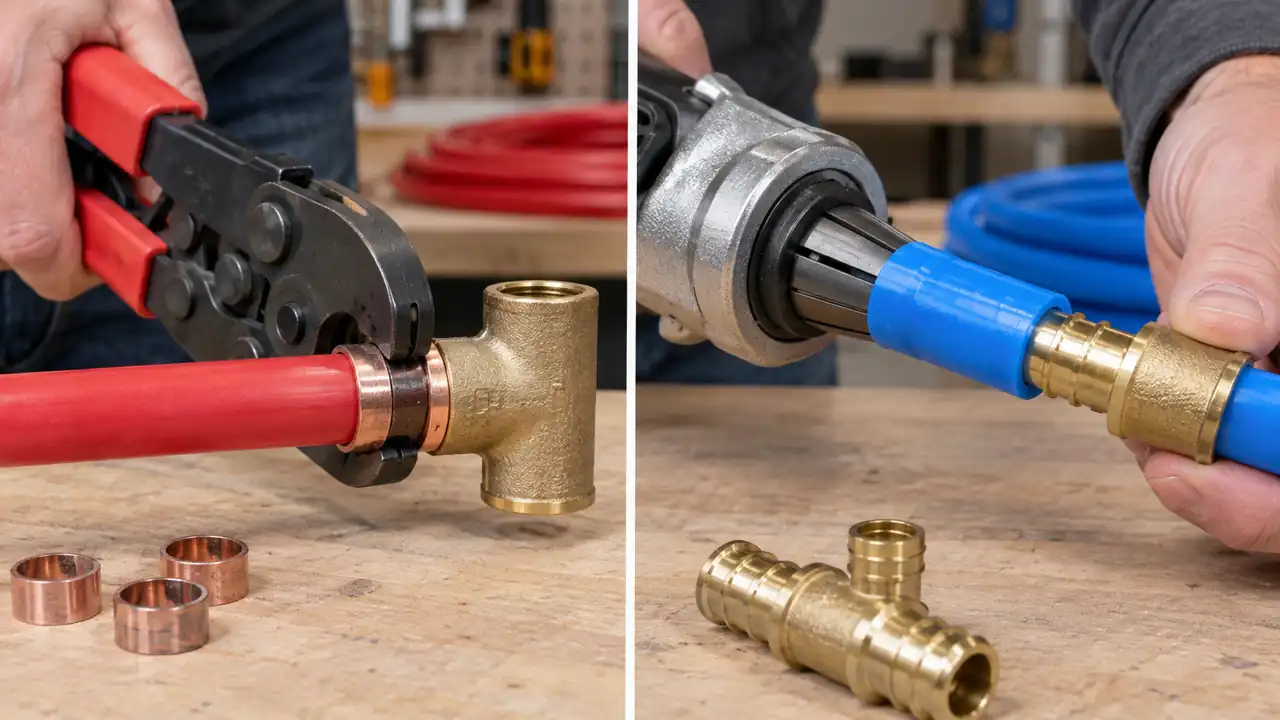
PEX crimp and PEX expansion are two different ways to join cross-linked polyethylene tubing to fittings. A crimp connection compresses a ring around the tubing and fitting. An expansion connection temporarily enlarges the tubing so it can slide over a larger fitting, then relies on the tubing’s memory to contract around the fitting.
Neither method is universally better. Crimp systems are usually simpler to source and require less expensive tooling. Expansion systems can provide a larger internal passage through compatible fittings and work well with flexible PEX tubing, especially PEX-A. The correct choice depends on the tubing type, fitting system, available tools, access, and the manufacturer’s compatibility requirements.
PEX Crimp vs Expansion at a Glance
| Factor | Crimp connection | Expansion connection |
|---|---|---|
| How it seals | A metal ring compresses the tubing around a fitting. | Expanded tubing contracts around a fitting, usually with an expansion ring. |
| Common tubing compatibility | Often available for PEX-A, PEX-B, and PEX-C when the tubing and fitting system are specified for crimp use. | Most commonly associated with PEX-A and fittings specified for expansion connections. |
| Primary tool | PEX crimp tool matched to the ring and fitting system. | PEX expansion tool with the correct cone or head for the tubing and fitting size. |
| Connection components | Crimp ring and insert fitting. | Expansion ring and expansion fitting. |
| Tool cost and complexity | Often lower and simpler for occasional work. | Usually requires a specialized expansion tool and compatible heads. |
| Fitting passage | The fitting may have a smaller internal passage than an expansion fitting of the same nominal tubing size. | The fitting is inserted inside the expanded tubing and may provide a larger internal passage, depending on the system. |
| Best fit for | Repairs, small projects, and installations where low tool cost and broad fitting availability matter. | Installations using compatible PEX-A tubing where flexibility and expansion fittings are useful. |
How a PEX Crimp Connection Works
A crimp joint uses a fitting inserted into the end of the PEX tube. A copper or other approved crimp ring is positioned over the tube and fitting, then compressed with a tool made for that ring system. The compressed ring holds the tubing against the fitting’s barbed section.
The ring must sit in the correct position over the fitting and must be compressed with the appropriate tool. A ring that is too far from the fitting, unevenly positioned, or compressed with the wrong tool can produce a joint that leaks or is difficult to verify.
Crimp system components
- PEX tubing approved for the selected crimp fitting system
- A compatible crimp fitting
- The correct crimp ring for the fitting and tubing size
- A PEX cutter that produces a square, clean cut
- A crimp tool matched to the ring type and size
- A gauge when the specific crimp system calls for one
Crimp tools are available in several forms. Some use interchangeable jaws for different tubing sizes, while others are dedicated to a particular size or ring type. A crimp tool for copper rings should not be assumed to work with stainless-steel clamp rings. Clamp connections use a different installation method and tool.
How a PEX Expansion Connection Works
An expansion joint uses an expansion ring and a fitting made for that connection method. The ring is placed over the tubing end. An expansion tool enlarges the tubing and ring enough for the fitting to be inserted. After the tool is removed, the tubing contracts around the fitting and creates the connection.
The tubing’s ability to contract is central to the process. The tubing, ring, fitting, tool, and installation technique must all match the specified system. Expansion fittings and rings are not interchangeable with ordinary crimp fittings.
Expansion system components
- PEX tubing approved for the expansion method
- Expansion rings specified for the tubing and fitting system
- Expansion fittings with the correct nominal tubing size
- A compatible manual, hydraulic, or powered expansion tool
- The correct expansion head for the tubing size and tool
- A clean, square tubing cut
Expansion tools must be used according to the instructions for the specific system. The number of expansion cycles, tool movement, insertion depth, and ring position can vary. Do not substitute a crimp fitting or a fitting from an unrelated connection system simply because the advertised tubing size appears the same.
Compatibility: The Decision Starts With the Tubing and Fittings
PEX type and connection method are related, but they are not the same classification. PEX-A, PEX-B, and PEX-C describe different manufacturing methods. They do not, by themselves, identify every connection method the tubing can use.
Crimp fittings are commonly available for several PEX types, provided the tubing and fittings are approved for that system. Expansion connections are commonly used with PEX-A because its material characteristics support repeated expansion and contraction. A particular tubing product still needs to be identified and checked against the fitting system.
Check each of these before buying parts:
- The actual PEX type and product specification
- The connection method supported by the tubing
- The fitting manufacturer’s stated compatibility
- The nominal tubing size, such as 1/2-inch or 3/4-inch
- The ring type and fitting type required for the connection
- The tool and jaw or head required for that system
A nominal tubing size describes the plumbing size category. It does not mean the tubing’s outside diameter is exactly that number. Fittings, rings, tools, and tubing must be matched by the system’s specified size rather than by visual comparison or a similar label.
Installation Differences That Affect the Choice
Crimp installation
Crimping generally involves cutting the tubing square, placing the ring in the correct position, inserting the fitting fully, and compressing the ring with the matching tool. The finished connection can often be checked visually, and some systems use a go/no-go gauge to verify the crimp.
The ring remains outside the tubing, so access around the joint is needed for the crimp tool. In a tight space, the tool’s handle movement and jaw width may determine whether the connection can be made comfortably.
Expansion installation
Expansion involves cutting the tubing square, positioning the ring, expanding the tubing in the required sequence, inserting the fitting to the specified depth, and allowing the tubing to contract. The expansion tool needs room to rotate or operate, depending on its design.
Expansion tubing may contract at different speeds depending on temperature and installation conditions. The fitting must be inserted fully and promptly after the tubing is expanded. Follow the instructions for the particular tubing and fitting rather than relying on a generic timing rule.
Which Method Is Easier for a DIY Repair?
Crimp is often the more approachable option for a small repair because the tools and fittings are widely available, and the connection process is comparatively direct. A basic crimp tool can also be less costly than an expansion tool, although tool quality and system compatibility still matter.
Expansion can be straightforward after the correct equipment and technique are available. The initial setup may involve more specialized tooling, and the tubing must be suitable for expansion connections. For a one-time repair, the cost and availability of the tool may favor crimp. For a larger installation using compatible PEX-A, expansion may fit the chosen piping system better.
Neither method should be selected solely because one tool is already on hand. Using the wrong ring, fitting, or tool can create a joint that looks assembled but does not meet the requirements of the connection system.
Flow and Fitting Size
Crimp and expansion fittings can have different internal designs. A crimp fitting commonly inserts into the tubing, while an expansion fitting is inserted after the tubing has been enlarged. That difference can affect the fitting’s internal passage and the restriction through the joint.
The effect on a complete plumbing run depends on tubing size, fitting count, run length, fixture demand, pressure, and system layout. A larger internal passage at one fitting does not automatically solve a flow problem caused by undersized tubing, a partially closed valve, a clogged filter, or another restriction.
Use the fitting manufacturer’s dimensions and system information when flow is a significant design concern. Do not compare fittings by nominal size alone. The nominal tubing size, fitting connection, and actual internal opening describe different measurements.
Durability, Flexibility, and Repairs
A properly made connection from either system can provide reliable service when the materials are compatible and the joint is installed correctly. Leaks are more commonly associated with incorrect preparation, poor positioning, incompatible parts, damaged tubing, or an improperly used tool than with the general concept of crimp or expansion.
PEX tubing flexibility depends on the tubing product and type. Expansion systems are frequently selected with flexible PEX-A, which can make routing around bends easier in some installations. Crimp systems can also be used with flexible tubing when the tubing is approved for that method.
Both connection types can be repaired, but the process differs. A damaged crimp joint generally requires cutting away the ring and fitting, preparing a new tubing end, and installing a new compatible connection. An expansion joint may require removing the fitting and ring from the affected section and preparing fresh tubing. Do not reuse rings, fittings, or damaged tubing unless the specific manufacturer instructions expressly allow it.
Leave access for future service where the plumbing layout requires serviceable joints. Concealed connections should follow the applicable installation requirements for the location and system.
Common Mistakes With Both Systems
- Mixing connection systems: A crimp ring, clamp ring, and expansion ring are different components and require different tools.
- Using the wrong tubing: PEX type and connection compatibility must be confirmed before assembly.
- Making an angled cut: A square cut helps the tubing seat correctly on the fitting.
- Leaving damaged tubing in place: Deep scratches, gouges, or crushed sections may prevent a reliable connection.
- Relying on appearance alone: A ring that looks properly positioned may still be incorrectly compressed or installed.
- Forcing a fitting: If a fitting will not insert or the tool will not operate correctly, stop and check the size, components, and procedure.
- Ignoring tool maintenance: Worn, damaged, or poorly adjusted tools can affect the finished joint.
- Testing too late: Pressurize and inspect new connections before closing walls, ceilings, cabinets, or other concealed areas.
When Crimp Is Usually the Practical Choice
Crimp is often a sensible choice for a small repair or a project where the following conditions apply:
- The existing tubing is approved for a compatible crimp system.
- Crimp rings and fittings are readily available in the required size.
- The lower tool cost matters.
- The work involves a limited number of connections.
- There is enough space to operate the crimp tool.
- A connection that can be visually checked is useful for the installation.
Crimp can also be appropriate for a broader installation, provided the selected tubing, rings, fittings, and tools are all part of a compatible system.
When Expansion May Be the Better Fit
Expansion may suit an installation where:
- The selected tubing is approved for expansion connections.
- The project already uses a compatible expansion fitting system.
- PEX-A flexibility is useful for the pipe layout.
- The fitting design and internal passage are important to the system plan.
- The installer has access to the correct expansion tool and heads.
- The connection method is being used consistently throughout the installation.
Expansion should not be chosen simply because the fitting has a larger-looking opening or because PEX-A is available. The complete tubing, ring, fitting, and tool combination must be specified for the method.
How to Choose Between PEX Crimp and Expansion
- Identify the tubing. Confirm whether it is PEX-A, PEX-B, PEX-C, or another product and check its approved connection methods.
- Choose the fitting system. Decide whether the project will use crimp fittings and rings or expansion fittings and rings. Do not mix the systems without specific compatibility information.
- Match the nominal size. Use the tubing and fitting size specified by the system. Do not rely on an outside measurement made with a ruler or on similar-looking labels.
- Check tool access. Measure the working space around the joint and confirm that the selected tool can operate there.
- Compare project needs. Account for tool cost, fitting availability, tubing flexibility, fitting design, and the number of connections.
- Follow the system instructions. Use the specified ring placement, tool, gauge, expansion procedure, insertion depth, and inspection method.
- Test before concealment. Restore water gradually, inspect every new joint, and correct any leak before closing the accessible area.
For most homeowners, crimp offers a practical and accessible connection method for compatible PEX repairs. Expansion can be an excellent fit for compatible PEX-A installations where its tubing and fitting design provide advantages for the layout. The dependable choice is the one that matches the tubing, fitting, ring, tool, and installation instructions as one complete system.
