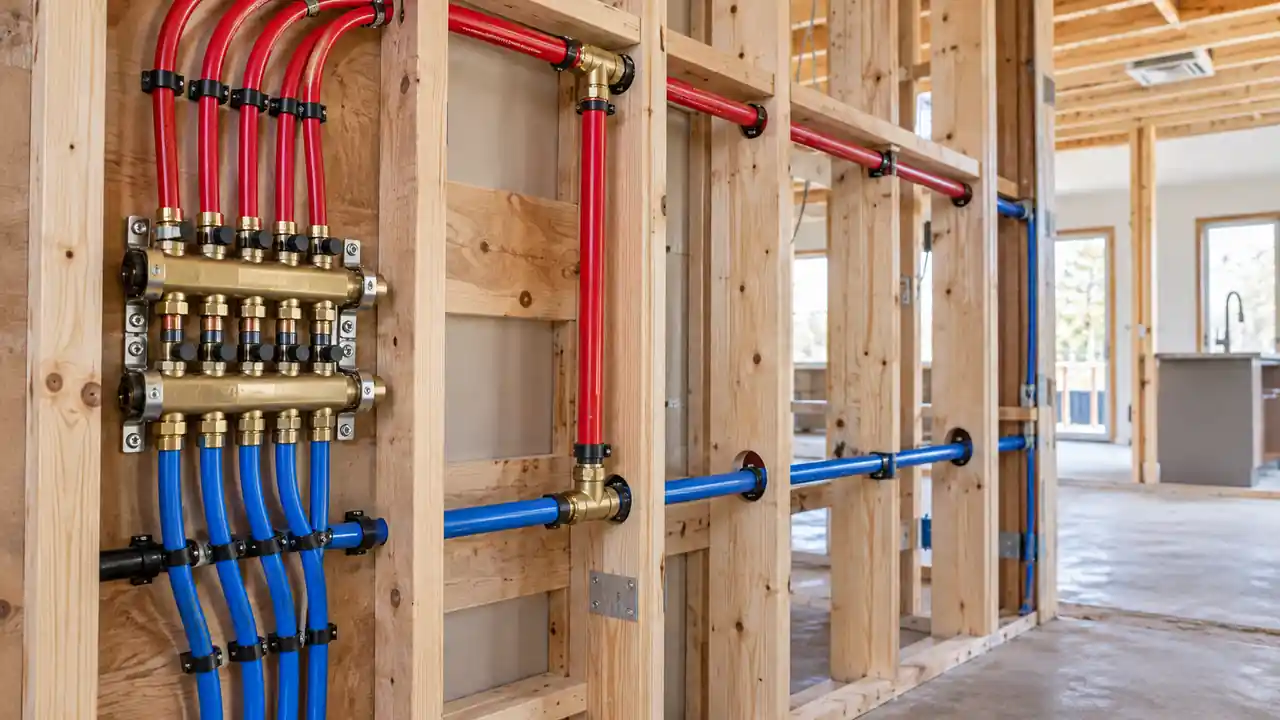
PEX tubing is commonly expected to last around 40 to 50 years or longer in a properly installed residential water-supply system. That is an estimate, not an expiration date or a guarantee. Its actual service life depends on water temperature, pressure, water chemistry, sunlight exposure, installation quality, and the condition of its fittings.
What affects how long PEX lasts?
PEX is made for specific operating conditions. Repeated exposure to hotter water and higher pressure can place more stress on tubing than cooler, lower-pressure service. Disinfectants in the water supply can also affect long-term durability, particularly on hot-water lines. The tubing must be suitable for the intended water and operating conditions.
Sunlight is another important limit. UV exposure can damage PEX before or after installation, so tubing should be stored and installed according to the manufacturer’s exposure limits. PEX intended for indoor supply piping should not be assumed suitable for an exposed outdoor run.
Installation matters as much as the tubing itself. Sharp bends, abrasion against building materials, unsupported runs, and incompatible fittings can lead to problems well before the tubing reaches its expected lifespan. A leak at a connection does not necessarily mean the length of PEX pipe has worn out.
Does PEX A, B, or C last longer?
PEX A, PEX B, and PEX C describe different manufacturing methods. The label alone does not establish that one type will last longer in a particular home. Product specifications, the intended application, installation conditions, and fitting compatibility are more useful than a blanket lifespan ranking.
Connection method is a separate question. Crimp, clamp, expansion, and other fittings must be used with tubing and tools specified for that system. A sound connection depends on the complete compatible assembly, regardless of which PEX type is installed.
Should old PEX be replaced?
Age alone is usually not a reason to replace PEX. A leak-free system near an estimated service-life range may continue working, while a newer installation can fail if it has been damaged or installed incorrectly. Pay closer attention to evidence of a problem:
- Recurring leaks, especially along the tubing rather than at one isolated fitting
- Visible cracks, splits, or damage from abrasion or sunlight
- Moisture or staining around connections
- Leaks appearing in several locations on the same system
A change in tubing color by itself does not establish that PEX has failed. If leaks keep recurring, particularly in concealed piping or across multiple locations, have the system evaluated before repeatedly patching individual spots. The cause may involve the tubing, fittings, installation, or operating conditions, and that distinction determines whether a local repair or broader replacement makes sense.
