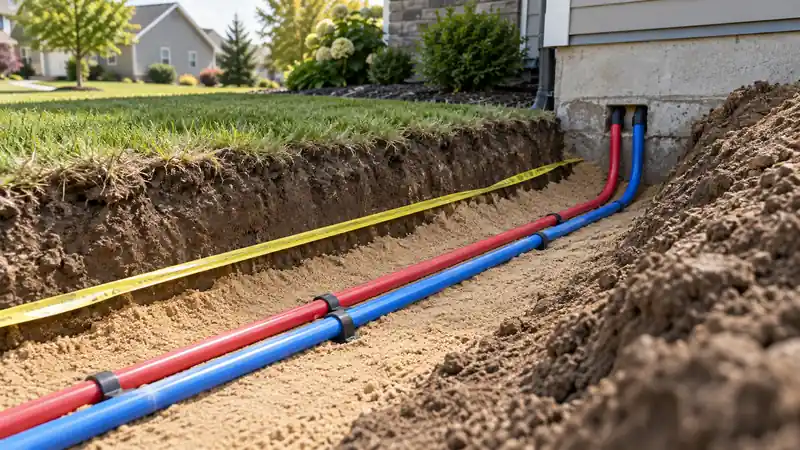
Yes, PEX can be used underground for many residential water-supply applications. The tubing must be approved for the intended service, installed according to its manufacturer’s instructions, protected from physical damage and sunlight, and buried in a way that satisfies local requirements. Standard PEX used for indoor plumbing should not automatically be assumed suitable for every underground, outdoor, or non-potable application.
Where Underground PEX Is Commonly Used
Underground PEX is commonly used for buried water lines between a building and an outbuilding, for water-service piping, and for sections of residential supply piping that pass beneath floors or slabs. Specialized PEX products may also be used in hydronic heating systems, but tubing intended for heating should be selected for that system rather than substituted for potable-water PEX.
The tubing identification, pressure and temperature ratings, intended use, and connection system all matter. A product labeled for potable water may differ from tubing intended for radiant heating, underground service, or other applications.
Conditions That Affect Whether PEX Can Be Buried
Use tubing approved for the application
Check the markings on the tubing and the product documentation before installation. Confirm that the PEX is suitable for the water system, temperature, pressure, and installation location. PEX type and connection method are separate issues. PEX-A, PEX-B, and PEX-C describe manufacturing methods. They do not, by themselves, determine whether the tubing can be buried or which fitting system must be used.
Protect it from sunlight
Ultraviolet light can damage PEX. Keep the tubing covered during storage and installation, and do not leave an exposed section above ground unless the product is specifically rated for that exposure. PEX passing through an exterior wall or foundation should be protected from abrasion, sharp edges, and other sources of physical damage.
Use suitable bedding and backfill
Rocks, broken concrete, scrap metal, and sharp construction debris can damage plastic tubing. Remove damaging material from the trench or use suitable bedding around the line. Backfill should support the tubing without creating concentrated pressure points.
The trench should also be clear of conditions that could crush, puncture, or sharply bend the tubing. A broad, gradual bend is generally preferable to forcing PEX around a tight corner. Follow the tubing manufacturer’s minimum bend guidance.
Account for freezing conditions
Burial does not automatically prevent freezing. The required depth depends on the local climate, soil conditions, exposure, and applicable requirements. A buried line in a cold region may need sufficient cover, insulation, heat protection, drainage, or another winterization method.
PEX can tolerate some expansion associated with freezing better than several rigid pipe materials, but that does not make a water line freeze-proof. Frozen water can still interrupt service and damage fittings or connected components.
Protect areas subject to surface loads
Lines under driveways, parking areas, foundations, or other locations exposed to vehicles and heavy loads may require additional protection. A sleeve, conduit, increased cover, or a different installation detail may be appropriate. The correct solution depends on the location and the requirements that apply to the project.
Can PEX Fittings Be Buried?
Whether a fitting may be installed underground depends on the fitting system, product instructions, and local requirements. Some PEX connection systems are suitable for concealed or buried installation. Others may require a specific protection method or accessible placement.
Do not assume that a crimp, clamp, expansion, push-to-connect, or other fitting is acceptable below grade merely because it connects to PEX. Verify all three parts of the installation:
- The tubing is approved for the application.
- The fitting is compatible with that tubing and connection method.
- The completed joint is permitted in the location where it will be installed.
Use a fitting made for the tubing’s actual connection system. A crimp tool is intended for compatible crimp fittings and rings. A clamp tool is intended for compatible clamp fittings. Expansion tools and fittings belong to systems specified for expansion connections. Similar-looking fittings are not automatically interchangeable.
Where a buried joint is permitted, inspect it carefully before covering it. Where the system requires accessible joints, route the tubing so those connections remain serviceable or use an approved transition detail.
Installing PEX Underground
The exact procedure varies with the pipe size, connection method, soil, climate, and local requirements. The general sequence below identifies the important decisions without replacing the instructions for the specific tubing and fittings.
- Plan the route. Mark the path and identify existing utilities before digging. Avoid unnecessary changes in direction and plan how the tubing will enter each building or structure.
- Confirm the material. Check the tubing markings, intended application, connection system, and required fittings. Do not substitute general-purpose indoor tubing without verifying its suitability.
- Prepare the trench. Remove sharp objects and create a base that supports the tubing continuously. The required depth and protection depend on local conditions and requirements.
- Protect building penetrations. Use a suitable sleeve or protective method where PEX passes through masonry, concrete, framing, or another abrasive surface. Seal and support the penetration using an appropriate detail for the structure and piping system.
- Lay out the tubing without damage. Avoid kinks, cuts, excessive twisting, and bends tighter than the manufacturer allows. Keep the ends clean and capped during installation.
- Make compatible connections. Prepare the tubing and install fittings using the specified tool, ring, clamp, sleeve, or other component. Do not modify a fitting to make an incompatible connection work.
- Pressure-test and inspect the line. Test the completed section using the method and conditions specified for the system. Check every joint and transition for leakage before the trench is closed.
- Backfill carefully. Place suitable material around the tubing first, then complete the backfill without dropping large rocks or debris directly onto the line. Maintain the required cover and protection at locations exposed to loads.
Underground PEX Compared With Other Common Materials
| Material | Practical underground characteristic | Important limitation |
|---|---|---|
| PEX | Flexible and available in long lengths with relatively few joints. | Requires protection from sunlight, sharp objects, crushing, and incompatible connections. |
| Copper | Rigid metal tubing that can be used in suitable underground applications. | More joints may be needed, and soil, water chemistry, and corrosion conditions can affect the installation. |
| PVC or CPVC | Rigid plastic piping used in applications approved for the specific material. | They use different joining methods and application limits. PVC and CPVC should not be treated as interchangeable. |
The best choice depends on the route, soil, climate, required connection points, accessibility, and applicable installation requirements. Flexibility alone does not determine whether a tubing product is appropriate for burial.
Situations That Need Extra Care
- Exterior water services: Verify that the tubing and transition fittings are approved for the service connection and burial conditions.
- Slabs and foundations: Protect tubing from abrasion and avoid burying an unverified connection beneath concrete.
- Transitions to rigid pipe: Use compatible adapters and support the transition so the PEX is not bent or pulled at the fitting.
- Hot-water lines: Confirm the tubing’s temperature rating and protect it from heat sources that exceed the product limits.
- Hydronic heating: Use tubing intended for the heating fluid and system conditions. Potable-water PEX is not automatically the correct choice for every heating loop.
- Gas piping: Ordinary PEX is not a substitute for an approved gas-piping material.
- Contaminated or unusual soil: Check whether the tubing manufacturer identifies restrictions for the soil or surrounding material at the site.
Problems That Can Result From Poor Underground Installation
A buried PEX line may leak because of a damaged tube, an improperly made connection, an incompatible fitting, excessive bending, movement at a transition, or damage that occurred during backfilling. A pressure test before covering the line can reveal many installation problems while the piping is still accessible.
If a buried line later loses pressure or produces unexplained moisture, inspect the accessible transitions first and check whether the water is actually coming from the underground section. Water can travel along soil, sleeves, or framing and appear some distance from the leak. Persistent loss of pressure, repeated repairs, or a concealed leak beneath a structure may justify professional locating and repair rather than repeated excavation.
For a specific project, confirm the tubing and fitting instructions, the required burial and protection details, and the applicable local plumbing requirements before closing the trench. That verification is especially important for service lines, foundation penetrations, buried joints, and piping beneath areas that will be difficult to access later.
