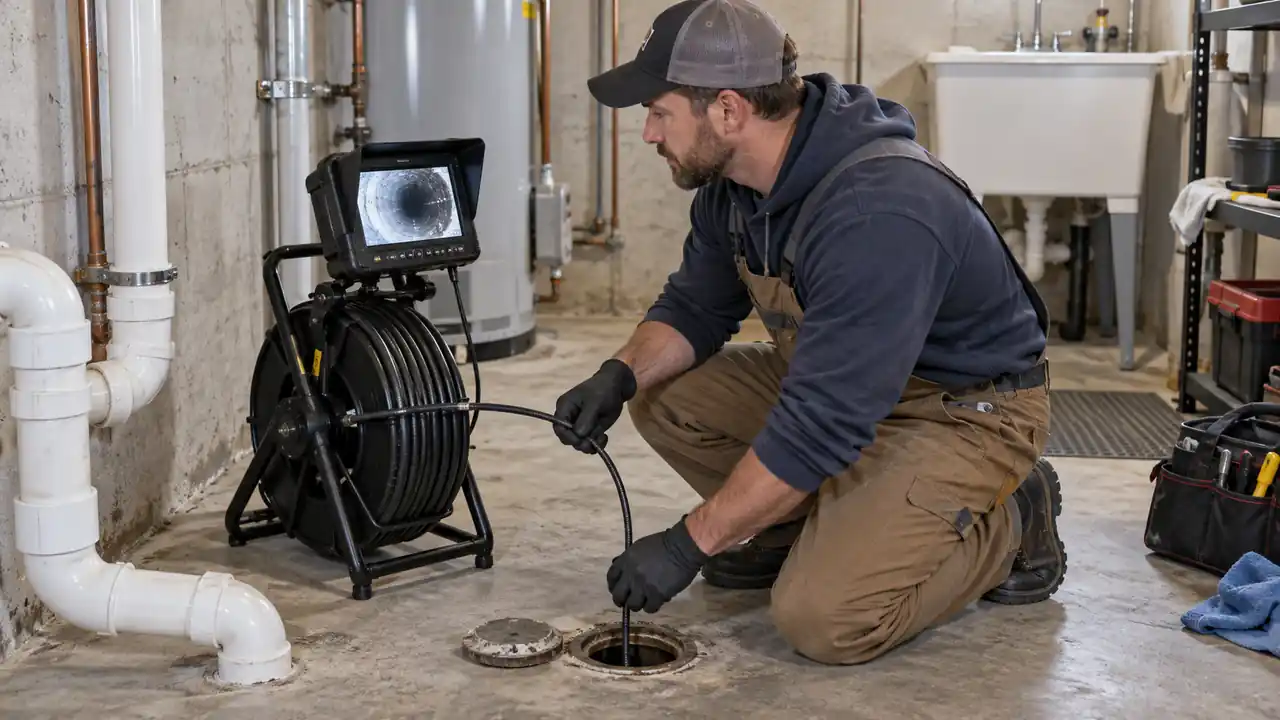
A plumbing inspection camera can turn a suspicious drain gurgle, slow fixture, or damp wall into something you can actually see. The right model helps identify buildup, cracks, standing water, corrosion, or a misplaced obstruction before you start removing drywall or guessing at the repair. The products in this roundup range from compact handheld borescopes for short inspections to 100-foot sewer camera systems with recording, distance markings, and larger screens.
The biggest buying mistake is choosing by resolution alone. A bright screen cannot compensate for a cable that is too short, a probe that will not fit the pipe, or a handheld scope that cannot document findings. Pay attention to camera-head diameter, cable length, cable stiffness, waterproof rating, recording capability, lighting, and whether the product is meant for plumbing lines or general inspection work. Different buyers have different priorities. For most homeowners and maintenance professionals, the Kcapyn 100-foot sewer camera offers the most useful balance of reach, display size, recording, and portability.
For a quick overview of the nine options, use the comparison table below, then jump to any product review for a closer look.
Quick Answer
- Best Overall: Kcapyn Sewer Camera 100FT for long pipe runs, recording, and a portable toolbox format.
- Best Professional-Style Upgrade: ChoosePRO HD1080P 18mm Sewer Camera for its 7-inch display, marked 100-foot cable, 16x zoom, and upgraded reel design.
- Best for Long Daily Inspections: Sewer Camera 100FT with 5-inch Display for its 32GB recording setup and stated 6 to 8 hours of battery use.
- Best Budget Handheld: Daxiongmao Endoscope Camera for basic household inspections without app setup.
- Best for Tight Angles: Teslong Articulating Borescope for steering the probe inside compact automotive, HVAC, wall, and plumbing spaces.
Best Plumbing Inspection Cameras Comparison Table
| Product | Best For | Type | Reach | Key Feature |
|---|---|---|---|---|
| Kcapyn Sewer Camera 100FT | Long residential and service inspections | Reel sewer camera | 100-foot cable | 5-inch screen, DVR, 32GB storage |
| ChoosePRO HD1080P Sewer Camera | Frequent professional-style work | Reel sewer camera | 100-foot marked cable | 7-inch IPS display, 16x zoom |
| Sewer & Drain Camera 100FT | Long runs through narrower pipes | Reel sewer camera | 100-foot cable | 17mm probe, DVR, meter counter |
| Sewer Camera 100FT with 5-inch Display | Documented sewer and drain inspections | Reel sewer camera | 100-foot cable | 32GB DVR, 5000mAh battery |
| Daxiongmao Endoscope Camera | Basic DIY checks and short access points | Handheld borescope | 16.5-foot cable | 4.3-inch screen, IP67 probe |
| Dual-Lens 5-inch Endoscope | Viewing pipe walls and tight bends | Handheld dual-lens scope | 16.4-foot cable | Front and side camera views |
| 1920P 16.5FT Endoscope | Simple plug-and-play inspections | Handheld borescope | 16.5-foot cable | 4.3-inch IPS display, 8 LEDs |
| Teslong Articulating Borescope | Steering around tight interior spaces | Articulating borescope | 5-foot gooseneck | Two-way articulation, IPS screen |
| Phone Dual-Lens Endoscope | Portable photo and video capture | Phone-connected scope | 16.4-foot cable | iOS and Android connection |
The detailed reviews below separate long-run sewer systems from compact borescopes, so you can match the camera to the access point, pipe length, and documentation needs.
1. Kcapyn Sewer Camera 100FT/30M Pipe Inspection Borescope: Best Overall

A 16-foot handheld borescope is handy for looking behind an appliance or inside a short drain branch, but it reaches its limit quickly on a residential sewer line. The Kcapyn is built around the longer inspection scenario, with a 100-foot semi-rigid cable, a 17mm camera, and a 5-inch display. That combination gives it the reach needed for many extended pipe runs while keeping the image on a dedicated screen instead of a phone.
The built-in DVR and 32GB storage make this system more useful for service calls, property maintenance, and before-and-after documentation. A homeowner tracking a recurring blockage can save footage for later comparison, while a technician can share recorded findings with a customer. The integrated toolbox also matters in practice. Long reels, screens, and small accessories can become a tangled mess in a truck, so a storage case that keeps the kit together adds real convenience.
Pros
- 100-foot cable reaches substantially farther than handheld borescopes.
- 5-inch display provides a larger viewing area for pipe inspection.
- Built-in DVR and 32GB storage support photo and video documentation.
- IP68 camera design is intended for wet and dirty pipe environments.
- Integrated toolbox keeps the inspection system and accessories organized.
Cons
- The 17mm camera head may not fit every narrow or sharply bent pipe.
- The reel system is less compact than a short handheld scope for quick household checks.
This is the most representative pick for buyers searching for a true plumbing inspection camera rather than a general-purpose borescope. It suits maintenance companies, serious DIY users, and homeowners dealing with long drain or sewer runs. Buyers who only need to inspect a trap, appliance cavity, or short branch line will likely prefer a smaller handheld model, since the full reel system adds storage and setup overhead. For broad residential pipe-inspection work, though, the reach, recording, screen, and case make this the most balanced package.
To buy this product, click here.
2. ChoosePRO HD1080P 18mm Sewer Camera: Best for Frequent Service Work

The ChoosePRO focuses on the parts of a sewer camera that become noticeable after repeated use. Its cable reel uses a twist-unlock system intended to release and secure the cable quickly, while the larger 7-inch IPS screen gives the operator more room to study a crack, rust patch, or obstruction. A technician working beside an open cleanout may appreciate that extra screen area, especially when the camera is moving through murky water and the details appear for only a moment.
The listing also specifies 16x zoom, a 32GB card, a marked 100-foot cable, and a 5000mAh battery with more than eight hours of stated use. Those features point toward longer inspection sessions and better documentation. The included sleeves help adapt the camera head for different pipe environments, while the spring tip is intended to help the probe navigate bends. This is a more substantial system than a basic handheld scope, though its 18mm camera head calls for careful attention to pipe access.
Pros
- Large 7-inch IPS display makes details easier to review in real time.
- 100-foot marked cable helps estimate the location of a suspected problem.
- 32GB DVR storage supports recording, playback, and file transfer.
- Twist-unlock reel design is intended to simplify cable handling.
- Long stated battery runtime suits extended inspection sessions.
Cons
- The 18mm camera head is less suitable for very narrow access points than slimmer probes.
- Its larger reel and screen require more transport and storage space than handheld scopes.
Choose this model if repeated inspections, clear viewing, and documentation matter more than compact storage. It is especially appealing for service-oriented users who want a large screen and marked cable without moving to a much more elaborate locating system. A homeowner who expects one occasional inspection may find the setup excessive, while a person managing multiple properties could make better use of the screen, recording, and battery capacity.
To buy this product, click here.
3. Sewer & Drain Camera 100FT, 4.3-inch HD: Best for Narrower Access

This system takes a different approach from the larger-screen sewer cameras. The listing identifies a 17mm probe and says it can fit into 1/2-inch pipes and tight bends. Buyers should still verify their actual access dimensions before purchasing, since pipe geometry and bends affect real-world passage, but the slimmer probe is the central reason to look at this model. A long cable is useful only if the camera can reach the inspection point without hanging up at the first turn.
The 4.3-inch display is smaller than the ChoosePRO screen, yet it includes DVR functionality, a 16GB microSD card, and photo and video capture. A 5000mAh battery, IP68 waterproof rating, six adjustable LEDs, and a built-in meter counter round out the system. That meter counter can help users estimate where a blockage or damaged section lies along the cable, which is useful before opening a floor or calling for a more involved repair.
Pros
- 17mm probe is aimed at narrower pipe access and tighter bends.
- 100-foot cable supports extended drain and sewer inspections.
- Built-in DVR captures photos and videos to the included 16GB card.
- Meter markings help estimate the location of an interior problem.
- IP68 camera rating and adjustable LEDs suit wet, dark environments.
Cons
- The 4.3-inch screen gives less viewing area than the 5-inch and 7-inch systems.
- The listed storage capacity is smaller than the 32GB options in this roundup.
This camera fits buyers who need long reach but want to pay close attention to probe size. It makes sense for drain maintenance, plumbing contractors handling varied access points, and homeowners who have already confirmed that a smaller head is valuable. Choose a larger-display model if several people need to view the screen together or if inspection records will be reviewed frequently. Here, the main advantage is access flexibility paired with a full-length reel.
To buy this product, click here.
4. Sewer Camera 100FT with 5-inch HD Display: Best for Documentation

Some inspections end when the camera comes out of the pipe. Others lead to a discussion about repair scope, responsibility, or recurring damage. This sewer camera is aimed at the second situation, with a 5-inch 1080P display, built-in DVR, and 32GB TF card for saving footage and photos. A digital record can help a property owner compare conditions over time, although the camera should still be handled and cleaned according to the manufacturer’s directions after dirty-water use.
The product listing describes a 17mm camera for pipes from 50mm to 200mm, plus a flexible spring tip and a protective cover for larger pipes. It also lists a 140-degree viewing angle, six adjustable LEDs, IP68 waterproofing, and a 5000mAh battery with stated 6 to 8 hour use. The 100-foot fiberglass cable includes a digital length counter. Together, these details make the unit suitable for users who want a more complete inspection record without moving to a more specialized locating instrument.
Pros
- 32GB storage provides room for repeated video and photo documentation.
- 5-inch 1080P display offers a useful middle ground between compact and oversized screens.
- 100-foot cable and digital length counter support long-run inspections.
- 17mm camera and flexible spring tip are intended for pipe navigation.
- IP68 waterproofing and adjustable lighting suit dark, wet interiors.
Cons
- The stated 50mm to 200mm pipe range does not cover every plumbing access situation.
- It is less convenient to carry for brief inspections than a handheld borescope.
This is a sensible pick for landlords, maintenance teams, and DIY users who want saved evidence rather than a live view that disappears when the job ends. The 5-inch screen is easier to carry than a 7-inch monitor while still giving enough area for detailed viewing. Buyers who need the narrowest possible probe should compare the stated dimensions with their pipe access first, and those who only need a short inspection should avoid paying the storage and reel penalty of a 100-foot system.
To buy this product, click here.
5. Daxiongmao Endoscope Camera with Light: Best Budget Handheld

The Daxiongmao is the kind of tool that can live in a household drawer until a strange plumbing problem appears. Its 4.3-inch color display works without Wi-Fi, a phone app, or driver software, so a user can power it on and start looking inside a short pipe, wall cavity, or appliance area. The 16.5-foot semi-rigid cable gives enough reach for many nearby access points, while the 8mm probe is slimmer than the long-run sewer camera heads in this roundup.
Eight adjustable LEDs help illuminate dark spaces, and the probe is listed as IP67 waterproof. The package includes a hook, magnet, and side mirror, which can be useful for retrieval and side-facing views in general inspection work. There is a key trade-off: this model cannot take photos or videos. That makes it a live-view troubleshooting tool rather than a documentation system. A homeowner checking whether an object is blocking a short drain may value the simplicity, while a contractor needing proof of a condition should select a recorder-equipped model.
Pros
- 8mm probe is suited to compact access points.
- 16.5-foot semi-rigid cable provides useful reach for household inspections.
- Dedicated 4.3-inch screen avoids phone pairing and app setup.
- Eight adjustable LEDs help illuminate dark interiors.
- Includes hook, magnet, and side mirror accessories.
Cons
- It cannot capture photos or videos for later documentation.
- Its 16.5-foot cable is a poor match for long sewer or main-line inspections.
This is the right kind of budget tool for quick diagnosis, especially behind fixtures, inside accessible drain branches, or around HVAC and automotive components. It is easier to hand to a homeowner than a reel camera, and the direct display reduces the chance of an app or connector issue interrupting the inspection. Skip it for recurring sewer investigations, customer reports, or any job where the footage needs to be saved. Its strength is immediate visibility, not long-distance surveying.
To buy this product, click here.
6. Endoscope Camera with Light, 5-inch 1080P Dual-Lens: Best for Side Views

A camera pointed straight ahead can show the obstruction in front of it, but a side view may reveal the scale of a crack, the edge of corrosion, or a connection branching away from the main path. This handheld scope provides front and side camera views that can be switched during an inspection. Its 5-inch screen and 170-degree stated viewing angle give the operator a comfortable live view, while the 16.4-foot semi-rigid cable can hold a bent shape as it moves through accessible spaces.
The 1.2 to 4-inch stated focus range is aimed at close inspection, and eight adjustable LEDs help manage dark pipe interiors. The probe is listed as IP67 waterproof, while the 2000mAh battery is specified for 3 to 4 hours of use. Like the Daxiongmao, it does not capture photos or videos. That keeps operation simple, but it limits the scope of the tool for service documentation. Think of it as a versatile visual probe for short-range plumbing, HVAC, and automotive work rather than a sewer reel system.
Pros
- Dual-lens design provides front and side viewing options.
- 5-inch display is larger than many compact borescope screens.
- 16.4-foot semi-rigid cable can hold useful inspection angles.
- Eight adjustable LEDs support viewing in dark spaces.
- Plug-and-play operation requires no Wi-Fi or phone app.
Cons
- It does not record photos or videos for inspection reports.
- The 3 to 4 hour stated runtime is shorter than the battery claims of the reel systems.
This model suits a buyer who often needs to look toward a pipe wall instead of simply pushing farther ahead. The side camera can reduce the need to repeatedly withdraw and reposition the probe, which is useful in short, accessible sections. A plumber surveying a 100-foot line should choose a reel camera instead, while a homeowner checking a drain cavity, duct, or engine compartment may find the dual view far more useful than a basic forward-facing scope.
To buy this product, click here.
7. Endoscope Camera with Light, 1920P HD 16.5FT: Best Simple Display

This endoscope keeps the workflow refreshingly short. Turn it on, guide the semi-rigid cable, adjust the LEDs, and watch the 4.3-inch IPS screen. There is no phone connection to configure, which can be welcome when your hands are wet or the inspection area is cramped. The listing also describes color flip and brightness adjustment, features that can make an upside-down or dim image easier to interpret.
The 7.9mm probe and short lens are aimed at confined spaces, while the IP67 rating is intended for wet environments. Its 16.5-foot cable puts it in the same general reach class as other handheld scopes, so it is better for nearby plumbing access than deep sewer lines. Like several compact models here, it cannot store photos. The included hook, magnet, and side mirror expand its usefulness beyond pipes, but they do not change its basic role as a live inspection camera.
Pros
- 4.3-inch IPS screen provides direct viewing without a smartphone.
- 7.9mm probe and short lens suit confined inspection points.
- Color flip and brightness adjustment can improve viewing from awkward angles.
- Eight adjustable LEDs help light dark spaces.
- 16.5-foot semi-rigid cable offers useful short-range reach.
Cons
- It cannot save photos or videos for later review.
- Its shorter cable does not address long sewer-line inspection needs.
Choose this scope for straightforward household troubleshooting, especially if you prefer a dedicated screen over a phone-connected design. It can help locate an object, inspect a visible section of pipe, or check a wall cavity before cutting. Buyers who need a record of the finding should move to a DVR-equipped camera, while anyone expecting to inspect a long branch line should compare cable length before purchase. The appeal here is ease, compactness, and a clean live image.
To buy this product, click here.
8. Teslong Articulating Borescope: Best for Tight Angles

Some inspection points are short but awkward. A probe may reach the cavity, yet the camera tip points at the wrong surface and refuses to turn with a simple push. The Teslong addresses that problem with a two-way articulating probe controlled by a joystick. Its 5-foot semi-rigid gooseneck is far shorter than a sewer reel cable, but it can be shaped and steered with more precision inside compact areas such as equipment housings, wall openings, HVAC spaces, and accessible plumbing cavities.
The 4.5-inch IPS screen provides a dedicated live view, and the listing describes built-in lighting plus buttons for capturing photos or videos. A centrally placed joystick is intended for one-handed operation, which can make the camera easier to guide while the other hand holds a flashlight, access panel, or tool. This is a specialty borescope rather than a long-run sewer camera. It earns consideration for maneuverability, not reach.
Pros
- Two-way articulation helps aim the camera around tight interior spaces.
- Joystick control supports one-handed probe steering.
- 4.5-inch IPS display provides a dedicated viewing screen.
- 5-foot semi-rigid gooseneck holds its general shape during inspection.
- Listing specifies photo and video capture capability.
Cons
- The 5-foot probe is too short for many extended plumbing-line inspections.
- Articulation adds a specialized control system that may be unnecessary for simple straight access.
This is a useful pick for people who repeatedly inspect tight, complicated spaces rather than long pipes. A maintenance worker trying to look behind a wall opening or around equipment can benefit from directing the camera tip instead of twisting the whole cable. For a sewer cleanout, the Kcapyn or another 100-foot system is a better match. The Teslong belongs in a different part of the toolbox, where controlled viewing matters more than distance.
To buy this product, click here.
9. 1920P HD Dual-Lens Endoscope for iOS and Android: Best for Phone-Based Capture

A phone-connected endoscope makes sense for buyers who want to save images or video directly to a familiar device. This model connects with supported iOS and Android devices through the included connectors and an app. Its dual-lens design provides front and side views, while the 16.4-foot semi-rigid cable gives it enough reach for many short plumbing, automotive, and home inspection tasks. A user checking a pipe cavity can record the view, send it to a repair professional, or keep it for comparison after a cleaning attempt.
The 7.9mm probe is listed as IP67 waterproof, and the product information describes underwater use up to 3.28 feet for one hour. That detail should be treated as an operating limit, not an invitation to leave the camera submerged. The system includes adjustable lighting, a hook, magnet, mirror, protective cap, and connectors for different devices. The trade-off is dependence on phone compatibility, app setup, and battery or screen availability. Some Android devices may display less clearly according to the listing.
Pros
- Dual-lens design allows front and side inspection views.
- Phone connection supports saving photos and videos.
- 7.9mm probe fits many compact access points.
- 16.4-foot semi-rigid cable suits short-range inspection work.
- Includes iOS, Android, and USB-C connection options plus retrieval accessories.
Cons
- Phone and app compatibility must be checked before purchase.
- The listing acknowledges that some Android devices may show slightly blurrier images.
This scope is appealing for a homeowner who wants a portable camera and easy digital sharing without carrying a separate monitor. It can also be useful for documenting a short inspection before asking a plumber for advice. Buyers who work in dirty or wet conditions may prefer a dedicated-screen model, since keeping a phone nearby can be inconvenient. For deep lines, the 16.4-foot cable remains the limiting factor, but for short visual checks and saved media, the phone workflow has a clear advantage.
To buy this product, click here.
Buying Guide for Plumbing Inspection Cameras
Start with the Inspection Distance
Measure the likely path from the access point to the area you need to view, then allow extra length for bends and handling. A 16-foot handheld scope can be useful inside a fixture branch or wall cavity, but it is a different tool from a 100-foot reel camera. A cable marking system helps estimate the camera’s position, though the marked distance does not guarantee that the camera can travel the full length through every bend.
Check the Camera Head Diameter
Probe size affects access more than a large resolution number printed on the package. The products here include compact probes around 7.9mm and 8mm, as well as larger 17mm and 18mm sewer camera heads. Measure the available opening and think about bends, fittings, and debris. A camera that fits through a straight opening may still struggle at a tight turn, so do not treat nominal pipe size and actual access clearance as interchangeable.
Understand Cable Stiffness
A semi-rigid cable needs enough firmness to push through a run, but excessive stiffness can make bends harder to navigate. Short handheld cables are easier to shape around a nearby access point. Reel systems provide much more reach but require more room to unwind, clean, and store. For repeated service work, a reel with organized cable storage can save time. For occasional DIY use, the extra reel may become cumbersome.
Choose the Right Display and Recording Setup
A dedicated display keeps your phone out of the work area and usually makes setup faster. Phone-connected models can make sharing photos and videos convenient, but they depend on connector and app compatibility. Some handheld cameras in this roundup provide live viewing only. That is adequate for finding an object or checking a suspected blockage, but it is less useful for reports, customer communication, or comparing a pipe before and after maintenance.
Screen resolution and camera resolution describe different parts of the system. A high-resolution display cannot create detail that the camera sensor did not capture. Look for clear information about both values, and avoid assuming that a number in the product title describes the camera itself.
Look at Waterproofing Carefully
IP67 and IP68 ratings appear on several products here, but they describe tested protection conditions rather than unlimited use in water. Follow the manufacturer’s instructions for submersion, cleaning, charging, and connector care. The camera head may be waterproof while the display, handle, or cable connection requires protection. Wipe the probe after dirty-water work and use the supplied protective cap where applicable.
Decide Whether You Need Location Information
A distance-marked cable or meter counter can help estimate how far the camera has traveled. That may guide an access decision, but it is different from an electronic sonde and locator system. None of the listed product information here verifies a sonde or underground locating transmitter, so buyers who need precise surface locating should search for that feature specifically rather than assume a distance counter provides it.
Match the Camera to the Work
For a short inspection behind a fixture, a compact handheld borescope is easier to store. For a long drain or sewer run, use a reel camera with enough cable, a probe suited to the access opening, and a screen that is easy to read outdoors or beside a cleanout. For awkward cavities, an articulating probe can provide more control than a longer straight cable. The longest camera is not automatically the best camera if the inspection point is close and difficult to steer.
Best Plumbing Inspection Cameras FAQ
What Is the Best Plumbing Inspection Camera for Most Homeowners?
The Kcapyn 100-foot sewer camera is the strongest broad match here because it combines long reach, a dedicated 5-inch display, recording, storage, and a portable toolbox. A homeowner who only needs to inspect short access points may find the Daxiongmao or another compact handheld scope easier to store and use.
Is a Handheld Borescope the Same as a Sewer Camera?
No. A handheld borescope usually has a shorter cable and is intended for nearby cavities, small plumbing access points, appliances, HVAC spaces, or automotive work. A sewer camera generally uses a reel and a much longer cable for extended pipe runs. The two categories overlap in basic camera function, but their reach, handling, and intended applications differ.
How Long Should a Plumbing Inspection Camera Cable Be?
Choose cable length based on the longest realistic inspection path, not the largest number available. A 16-foot cable can suit a nearby drain branch or wall cavity. A 100-foot cable is more appropriate for extended sewer and drain runs. Bends, fittings, and cable handling reduce practical reach, so leave some margin rather than selecting a length that exactly matches the measured distance.
Does a Higher Resolution Guarantee a Better Inspection?
No. Image quality also depends on lighting, lens focus, camera sensor, screen brightness, pipe conditions, and the operator’s ability to guide the probe. A bright adjustable LED system and a suitable probe diameter can matter more than a larger resolution claim if the camera cannot reach the area or the image is washed out by standing water.
Do These Cameras Locate a Pipe Problem from Above Ground?
The listed products provide cable markings or a meter counter on some models, but the supplied information does not verify an electronic sonde or locating transmitter. Cable distance can provide an estimate of camera travel. It should not be treated as the same feature as surface locating.
Can These Cameras Be Used in Water?
Several models list IP67 or IP68 protection for the camera section. Use them within the limits stated by the manufacturer, and protect the display, controls, charging port, and cable connections as directed. Waterproofing does not remove the need to clean and dry the equipment after a wet or dirty inspection.
Should I Choose a Phone-Connected Camera or a Dedicated Screen?
A phone-connected camera is convenient for saving and sharing short inspection clips, provided your device and the required app are compatible. A dedicated-screen camera is easier to use when your phone needs to stay clean, dry, or available for another task. Users who dislike app setup will generally prefer a handheld model with its own display.
What Should I Do Before Pushing a Camera into a Drain?
Confirm the camera-head size, inspect the access opening, review waterproofing instructions, and clean the lens before use. Avoid forcing the cable around a bend. If it catches, withdraw slightly and change the angle rather than pushing harder. Afterward, clean and dry the probe and cable according to the product instructions.
Final Verdict
The Kcapyn Sewer Camera 100FT is the best overall choice in this group because it addresses the core reason people search for a plumbing inspection camera: seeing farther into a pipe while keeping a useful record of what appears on screen. Its 100-foot cable, 5-inch display, DVR, 32GB storage, and toolbox make it more practical for serious residential inspections than a short handheld scope. The ChoosePRO is the stronger premium-style alternative for buyers who value a 7-inch screen, zoom, marked cable, and a longer stated battery runtime.
For narrower access, the 17mm Sewer & Drain Camera provides a useful long-run alternative, while the 5-inch 100-foot sewer camera suits buyers who want extensive video and photo storage. If the job is a short household check, the Daxiongmao offers a simpler and more compact path without app setup. Match the camera to the access opening, inspection distance, need for saved footage, and storage space available in your toolbox. That approach will do more for a successful inspection than choosing by resolution alone.
