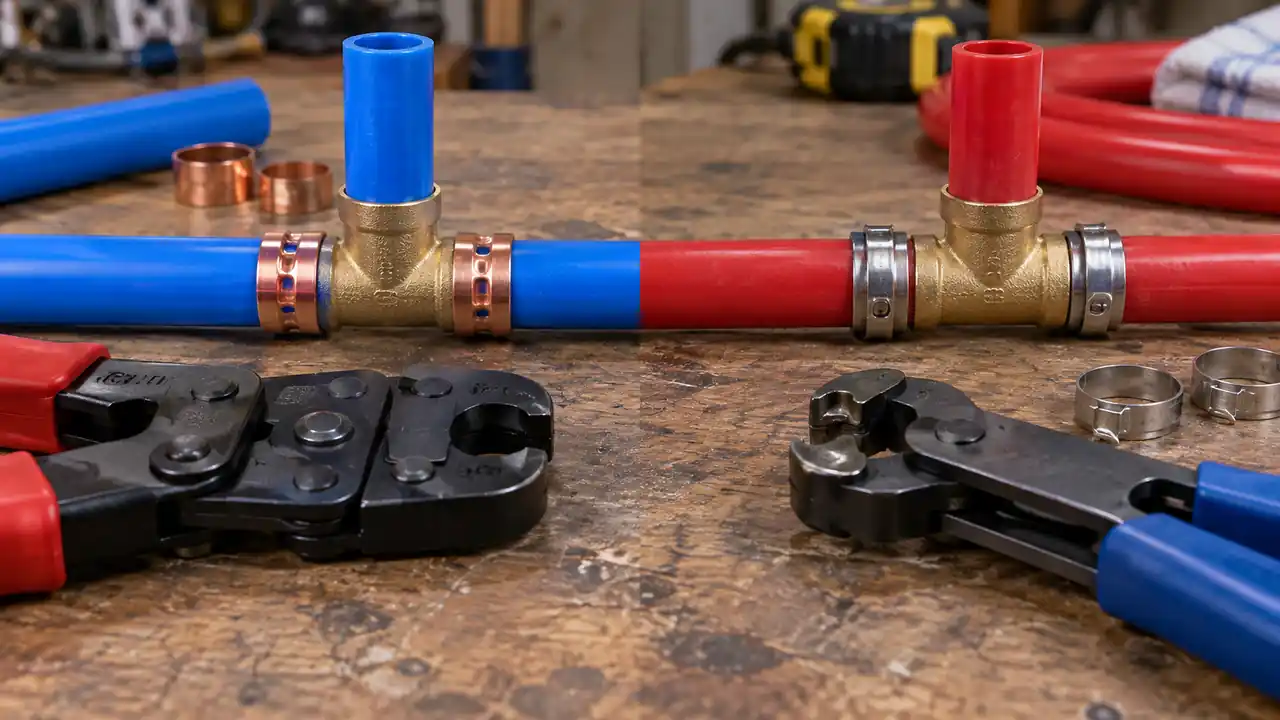
PEX crimp and clamp connections use the same basic approach: a metal ring secures PEX tubing over an insert fitting. The difference is how the ring tightens. A crimp tool compresses a copper ring around its circumference, while a clamp tool closes a raised ear on a stainless steel clamp. Neither method is inherently the better choice for every installation. Fitting compatibility, tool access, and the sizes you work with matter more.
Crimp and clamp at a glance
| Feature | PEX crimp | PEX clamp |
|---|---|---|
| Ring | Copper crimp ring | Stainless steel clamp with a raised ear |
| Tool action | A correctly sized jaw compresses the ring | A clamp tool closes the ear |
| Tool sizing | The jaw must match the ring size | Some tools cover multiple clamp sizes; check the tool’s listed range |
| Access needed | Room to position the jaw around the ring | Room to reach and close the clamp ear |
Both methods make a permanent connection intended to remain in place. If a joint is assembled incorrectly, the remedy is generally to cut out and remake it with compatible components, rather than squeeze the ring repeatedly or try to seal the joint from the outside.
What changes during installation?
For either method, the tubing needs a clean, square cut and must seat fully on the insert fitting. The ring or clamp must sit in the position specified for that fitting system. A crooked cut, incomplete insertion, or misplaced ring can compromise either type of connection.
With crimp, the installer positions the appropriate crimp jaw squarely over the copper ring and completes the tool stroke. Many crimp systems provide a go/no-go gauge for checking the finished ring. The gauge and tool instructions should match the ring system being used.
With clamp, the installer positions the clamp ear where the tool can reach it, then fully closes the ear with a compatible clamp tool. The finished ear should be checked according to the clamp and tool instructions. A crimp go/no-go gauge is not a substitute for the specified clamp check.
Tool clearance can settle the choice in a tight space. A crimp jaw needs to fit around the ring; a clamp tool needs a workable angle on the ear. Before making a connection near a stud, manifold, or other obstruction, check that the tool can complete its stroke without twisting the tubing or fitting.
Which tubing and fittings work with each method?
PEX A, PEX B, and PEX C describe types of tubing, not a required connection method. Tubing may be suitable for crimp or clamp insert fittings when the specific tubing, fitting, ring, and tool are approved to work together. PEX A is not restricted to expansion connections, and PEX B is not restricted to crimp connections.
Do not choose parts by appearance or nominal size alone. A ring labeled for a given PEX tubing size is meant to match that nominal tubing size, which does not state the tubing’s exact outside diameter. Confirm that the fitting is intended for the selected crimp or clamp system, that each component matches the tubing size, and that the tool supports the ring or clamp. Manufacturer-specific and expansion fittings require their specified connection methods; they cannot be made into crimp or clamp fittings by changing the ring.
If the same approved insert fitting and tubing are used, changing from a crimp ring to a clamp does not by itself create a meaningful flow advantage. Fitting design and size affect the water passage through the connection.
Choosing between crimp and clamp
- Choose crimp if you already have correctly sized crimp jaws and a compatible gauge, or if you prefer a full-ring compression method and have room to place the jaw.
- Choose clamp if a compatible clamp tool covers the tubing sizes you use, or if the ear is easier to reach than it would be to position a crimp jaw around the ring.
- Stay with the specified system if an existing installation or fitting manufacturer calls for particular components. Do not mix rings, tools, and fittings on the assumption that all insert connections are interchangeable.
After either connection is made, inspect it using the checks specified for that system and check for leaks when the water supply is restored. If the tool could not close properly, the fitting shifted, or the joint fails its required check, remake the connection rather than leaving an uncertain joint inside a wall or other concealed space.
