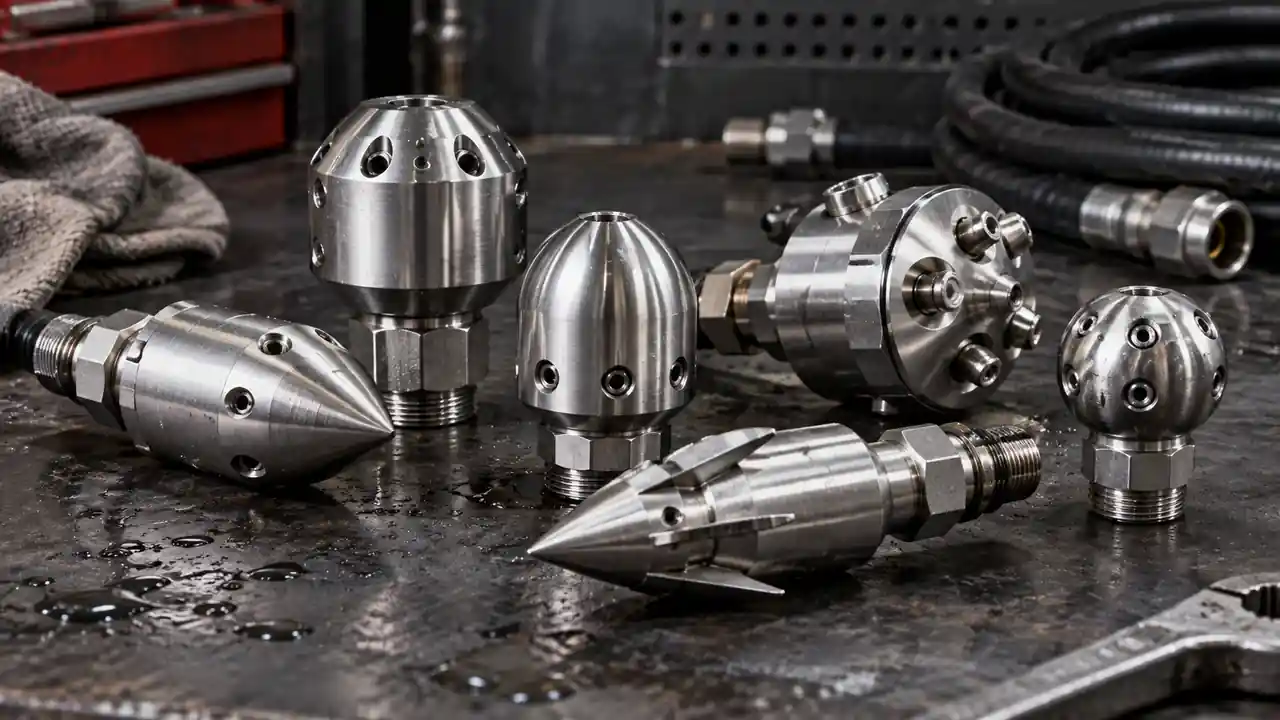
A sewer jetter nozzle can turn a pressure washer into a useful drain-cleaning tool, but the nozzle at the end of the hose determines how that water behaves inside the pipe. A forward jet can attack a stubborn obstruction, rear-facing jets can pull the hose through the line, and rotating designs can scrub buildup around the pipe wall. The wrong connection, orifice, jet pattern, or pressure rating can leave you with a nozzle that fits poorly, moves slowly, or fails to clean the area that caused the blockage in the first place.
Shoppers often focus on the highest PSI number and overlook thread size, flow requirements, hose compatibility, and the difference between a simple fixed nozzle and a rotating head. A homeowner clearing a short branch drain may prefer a compact 1/4-inch quick-connect set, while a plumber working on longer sewer runs may need a 3/8-inch NPT head, substantial flow, or a complete hose kit. Our top overall pick is the Sewer Jetter Nozzle Kit 3-Pack because it covers the most useful basic spray patterns in one compact set, although the professional-oriented rotating heads and 100-foot kits below make more sense for demanding jobs.
For a quick look at the nine finalists, the table below compares their main nozzle styles, connections, and intended uses.
Best Sewer Jetter Nozzles Comparison Table
| Product | Best For | Type | Connection and Key Specification |
|---|---|---|---|
| Sewer Jetter Nozzle Kit 3-Pack | Most DIY drain-cleaning jobs | Rotating, button nose, and fixed set | 1/4-inch quick connect, up to 5000 PSI |
| Tool Daily 3/8-inch NPT Rotating Nozzle | High-flow residential and commercial cleaning | Rotating multi-jet head | 3/8-inch NPT, 40 L/min, up to 3000 PSI |
| ZOFINE 100FT Sewer Jetter Kit | Longer runs and varied drain layouts | Hose and multi-nozzle kit | 100-foot hose, 1/4-inch NPT accessories, up to 5800 PSI |
| 3/8-inch Rotary Sewer Jetter Nozzle | Heavy-duty pipe-wall cleaning | Weighted rotating torpedo head | 3/8-inch female connection, up to 10.6 GPM and 40 L/min |
| 10-Piece Sewer Jetter Nozzle Kit | Users needing several nozzle and connector sizes | Multi-size nozzle kit | 1/4-inch and 3/8-inch NPT connectors, up to 5000 PSI |
| MIZORLIE Pressure Washer Jetter Nozzle | Simple single-nozzle setups | Fixed multi-jet head | 1/4-inch quick connect, one forward and six rear jets |
| 100FT Sewer Jetter Kit | Homeowners who need hose and nozzles together | Hose and four-nozzle kit | 100-foot hose, M22 to 1/4-inch NPT adapter, up to 5800 PSI |
| TasuoX 3/8-inch NPT Jetter Nozzle | Focused multi-jet cleaning | Seven-jet fixed head | 3/8-inch NPT, 40 L/min, up to 3000 PSI |
| Sewer Jetter Nozzle Kit 4-Pack | Tight bends and mixed household tasks | Rotating, button nose, pointed, and corner set | 1/4-inch quick connect, up to 5000 PSI |
Readers who want more detail can use the reviews below to match each spray pattern and connection style with the pressure washer and pipe-cleaning job they already have.
1. Sewer Jetter Nozzle Kit, 3-Pack — Best Overall
The main appeal of this three-piece kit is its useful spread of spray patterns. It includes rotating, button nose, and fixed rear-jet nozzles, so a homeowner can switch strategies instead of trying to force every clog with one head. The rotating model is aimed at broader pipe-wall coverage, while the button nose design provides a forward stream for breaking through a blockage. That is a practical combination for the messy Saturday-morning scenario where a drain starts backing up and the cause is still unclear.
All three nozzles use 1/4-inch quick-connect fittings and are listed for pressure washer use up to 5000 PSI. The stainless steel construction is suited to wet, corrosive cleaning work, and the rotating nozzle is described with a brass core. Buyers should still match the nozzle to their machine’s actual pressure and flow requirements rather than treating the maximum rating as a performance guarantee. For common residential drain, irrigation-tube, outdoor pipe, and RV-tank tasks, this set offers more flexibility than a single fixed head without requiring a large kit.
Pros
- Includes rotating, button nose, and fixed rear-jet patterns.
- Uses a familiar 1/4-inch quick-connect format.
- Stainless steel construction is suited to wet cleaning work.
- Rotating coverage can help address buildup around pipe walls.
- Useful for homeowners who are unsure which nozzle style a blockage requires.
Cons
- It does not include a sewer jetting hose.
- Buyers with 3/8-inch NPT equipment may need a compatible adapter or a different nozzle.
This is the most balanced pick for a pressure-washer owner building a basic jetting setup from individual components. It is especially useful for occasional maintenance, branch drains, and situations where changing from a penetrating spray to a broader cleaning pattern matters. A professional handling long main lines may prefer a weighted 3/8-inch head or a complete 100-foot kit, but those products also require more attention to flow, fittings, and working conditions. If your existing equipment accepts 1/4-inch quick connects, this three-pack is the clearest starting point.
To buy this product, click here.
2. Tool Daily 3/8-inch NPT Sewer Jetter Rotating Nozzle — Best for High-Flow Systems
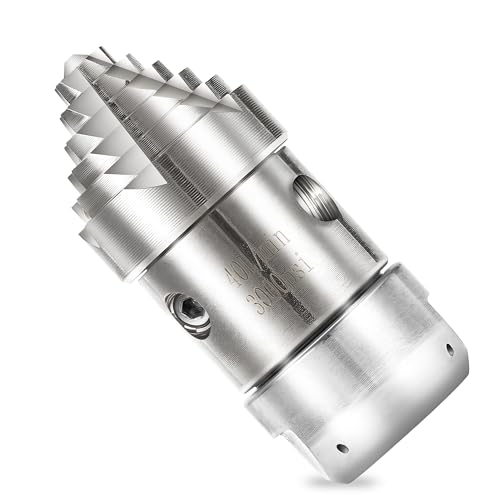
The Tool Daily head is aimed at buyers who already have a more substantial hydro-jetting setup. Its 3/8-inch internal thread is different from the 1/4-inch quick-connect fitting found on compact pressure-washer accessories, so compatibility should be checked before purchase. The listing specifies a maximum flow rate of 40 L/min and a maximum working pressure of 3000 PSI. Those figures make the nozzle relevant to equipment capable of delivering strong water volume, rather than a small pressure washer chosen by pressure number alone.
Its rotating action is the central feature. The head uses three 60-degree rear jets and four 30-degree rear jets, a pattern intended to propel the nozzle while washing the interior surface. Picture a greasy line where water still passes but the pipe wall has collected a sticky ring of residue. A rotating head can spread the cleaning action around that surface instead of concentrating every stream in one direction. Stainless steel construction adds corrosion resistance, although the machine, hose, and fittings must still be matched as a complete system.
Pros
- Rotating action covers the interior pipe wall.
- Uses seven rear jets in two listed spray angles.
- Supports a listed flow rate of up to 40 L/min.
- 3/8-inch NPT threading suits compatible hydro-jetting hoses.
- Stainless steel construction is intended for demanding wet work.
Cons
- It is not a direct 1/4-inch quick-connect replacement.
- The 3000 PSI and 40 L/min ratings require careful equipment matching.
This nozzle suits a buyer who values pipe-wall coverage and already owns a 3/8-inch hose or pump connection. It is less convenient for someone assembling a small, quick-connect pressure-washer kit from scratch. Compared with a fixed seven-jet head, its rotating design focuses more on broad cleaning action, while the trade-off is a greater need to verify fittings and flow before connecting it. For commercial maintenance or stubborn buildup in larger lines, that extra system planning can be worthwhile.
To buy this product, click here.
3. ZOFINE Sewer Jetter Kit for Pressure Washer 100FT — Best Complete Kit for Varied Runs
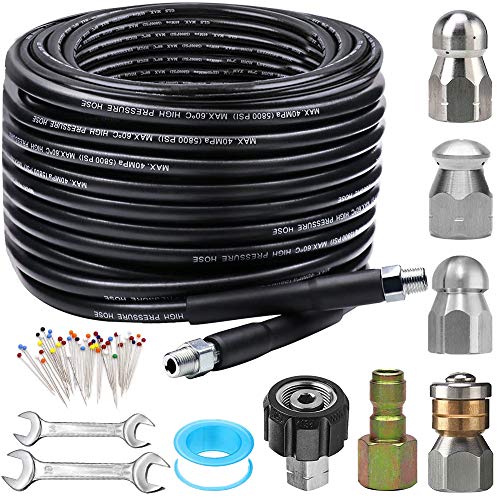
A nozzle is only as useful as the hose that can carry it to the blockage, and the ZOFINE kit addresses that part of the setup with a listed 100-foot sewer jet hose. The package also includes button nose, rotating, side-hole, and corner-style nozzles, plus an M22 female to 1/4-inch female NPT coupler, quick-connect plug, wrenches, waterproof tape, and cleaning pins. That spread is helpful in a house with several drain layouts. A straight run may favor the button nose, while a bend or awkward corner may call for a side-spraying head.
The hose is listed for pressure washers up to 5800 PSI and uses a polyester reinforcement layer with a thermoplastic polyurethane cover. Those material descriptions point to a hose intended for abrasion and outdoor handling, but the pressure washer’s flow and connection arrangement still need to match. The four nozzle styles also make this kit more adaptable than a single-head package. A new user should take time to identify the included fitting and secure every connection before pressurizing the line, especially after switching between adapters.
Pros
- Includes a listed 100-foot jetting hose.
- Offers rotating, button nose, side-hole, and corner nozzle styles.
- Includes an M22-to-1/4-inch NPT coupler and quick-connect plug.
- Supplies wrenches, tape, and cleaning pins for setup and maintenance.
- Useful for longer residential runs and varied pipe paths.
Cons
- The many fittings require careful confirmation of thread compatibility.
- A 100-foot hose may be more equipment than a short branch-drain job needs.
This is a sensible package for a homeowner who lacks both a jetting hose and a selection of nozzle patterns. The strongest reason to choose it is coverage, not a single standout nozzle. Buyers with an established 3/8-inch commercial system may prefer a dedicated heavy-duty head, while someone with only a compact pressure washer should confirm the manufacturer’s flow requirements first. For larger properties, basement lines, and outdoor drainage routes, the longer hose and corner-oriented nozzle can save repeated repositioning.
To buy this product, click here.
4. 3/8-inch Rotary Sewer Jetter Nozzle — Best Premium Heavy-Duty Head
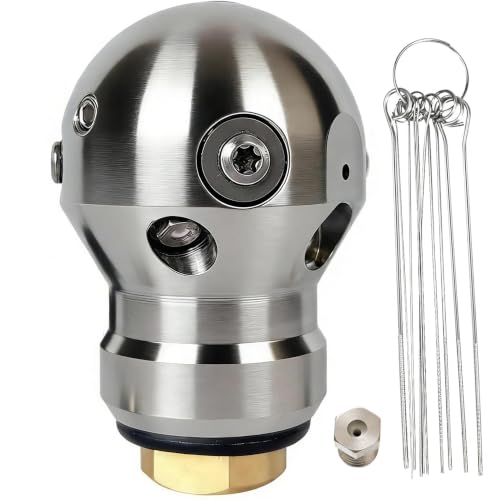
This torpedo-style head is built around a more substantial hydro-jetting format than the compact 1/4-inch accessories in this roundup. The listing gives the head a 1.47-pound weight and describes it as suitable for 2-inch to 6-inch drain lines, sewer laterals, and mainline pipes. That weight can help the head stay low in the line and move through sludge, grease, and mineral scale, while the rear jets provide forward propulsion. For a maintenance crew facing a long, dirty run, that physical design is more relevant than a large package count.
The rotating head uses a ceramic core and stainless steel tips with forward and rear jets. The forward jet is intended to attack compacted debris, while angled rear jets push the head along and scrub the pipe surface. It uses a 3/8-inch female connection and is listed for systems up to 40 L/min, or 10.6 GPM. These are meaningful requirements. This is a nozzle for a compatible high-flow setup, not a universal attachment for every consumer pressure washer sitting in a garage.
Pros
- Weighted torpedo body is intended to stay low in the pipe.
- Rotating action distributes cleaning around the pipe wall.
- Ceramic core is specified for the rotating head.
- Forward and rear jets address blockage and propulsion duties.
- Listed for 2-inch to 6-inch drain lines and high-flow systems.
Cons
- Its 3/8-inch connection is less convenient for compact quick-connect equipment.
- The heavier professional-style body may be unnecessary for short household drains.
Choose this head when the job involves longer lines, heavier deposits, or frequent cleaning with a suitable hydro-jetting system. It is a poor match for a buyer who needs a small nozzle for occasional sink-line maintenance, since the connection and flow requirements are more specialized. The premium design is justified by the weighted body, rotating mechanism, ceramic core, and stated pipe-size range, but those benefits only appear when the pump, hose, and fittings can supply what the head needs.
To buy this product, click here.
5. 10-Piece Sewer Jetter Nozzle Kit — Best for Connector Flexibility

This kit focuses on variety across nozzle and connector sizes. The package includes eight sewer jetter nozzles described across 3/8-inch, 1/8-inch, and 1/4-inch formats, along with one 1/4-inch NPT quick connector and one 3/8-inch NPT quick connector. That arrangement is useful for a buyer whose pressure washer hose and existing jetting accessories do not all use the same connection. It also gives a maintenance closet several spare heads for different drain-cleaning tasks.
The nozzles are listed as stainless steel and rated up to 5000 PSI. The listing specifically says the kit is for pressure washers and sewer jetting hoses, not garden hoses or standard water pipes. That warning matters because a garden hose may look similar at a glance but does not provide the same high-pressure operating conditions. A homeowner facing a stubborn outdoor line may appreciate the extra connector options, while a buyer who already knows the exact nozzle pattern needed could find this kit’s assortment more extensive than necessary.
Pros
- Includes eight nozzle heads in several listed connection sizes.
- Supplies both 1/4-inch and 3/8-inch NPT quick connectors.
- Stainless steel construction is suited to wet, high-pressure work.
- Listed for pressures up to 5000 PSI.
- Useful for households or shops with more than one jetting connection format.
Cons
- The assortment requires careful identification of each nozzle and fitting.
- It is unsuitable for garden-hose-only equipment.
This package makes the most sense for a buyer who values connector flexibility and wants several replacement or task-specific heads on hand. It is less focused than the three-pack, so someone seeking a simple first purchase may prefer a smaller set with clearly defined spray patterns. Check the pressure washer, hose, and nozzle threads as a complete chain before use. The real advantage here is the breadth of fittings and heads, not a claim that every included piece will suit every pipe.
To buy this product, click here.
6. MIZORLIE Pressure Washer Sewer Jetter Nozzle — Best Simple Fixed Head

The MIZORLIE nozzle keeps the format straightforward. It is a single stainless steel jetter with a 1/4-inch quick plug, one forward jet hole, and six rear-side jet holes. That arrangement gives the head a forward stream for working at an obstruction and rear streams for propulsion through the drain. There is no bundle of specialized pieces to sort through, which can be appealing when the existing pressure washer already has a compatible hose and the user wants a replacement or basic working head.
A fixed multi-jet nozzle also has a different personality from a rotating head. It sends its streams in a set pattern, so it may be easier to understand and maintain, but it does not provide the same rotating pipe-wall coverage described for the Tool Daily or premium rotary models. Imagine flushing a relatively open line after clearing a clog. A forward-and-rear fixed pattern can be perfectly practical there, while heavy circumferential buildup may call for a rotating design.
Pros
- Simple single-nozzle configuration.
- Uses a 1/4-inch quick-connect plug.
- Includes one forward and six rear-side jet holes.
- Stainless steel construction is suited to drain cleaning.
- Easy to compare with a pressure washer setup that already uses 1/4-inch fittings.
Cons
- It does not provide rotating pipe-wall coverage.
- The package contains one nozzle rather than multiple spray patterns.
This is a practical pick for a buyer who knows a fixed forward-and-rear configuration fits the job. It may also work well as a spare head stored with a pressure washer, ready for a drain or pipe-flushing task without opening a larger kit. Buyers dealing with unknown clogs, tight bends, or widespread wall buildup may gain more from a rotating or multi-nozzle set. Its appeal is simplicity, and that can be exactly what a basic setup needs.
To buy this product, click here.
7. 100FT Sewer Jetter Kit for Pressure Washer — Best Complete Home Kit
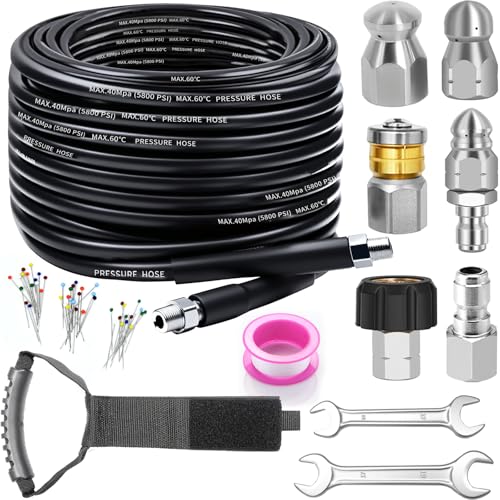
This 100-foot kit is built for the buyer who needs the hose as much as the nozzle. It includes a listed 100-foot sewer jet hose, an M22 female to 1/4-inch female NPT coupler, a quick-connect plug, four different sewer jetter nozzles, waterproof tape, two spanners, and cleaning pins. That collection can be handy after a move or for a property with basement drainage, yard lines, septic-tank lines, or longer household runs. Instead of assembling each part separately, the buyer receives a broad starting package.
The hose is described as a triple-layer construction with a corrosion-resistant inner tube, polyester braid reinforcement, and an abrasion-resistant polyurethane cover. The kit is listed for pressure washers up to 5800 PSI, while its nozzle selection includes rotating, side-spraying, mushroom, and button nose styles. Those patterns have different jobs. The rotating nozzle addresses wall coverage, the side spray is aimed at corners, and the button nose uses a forward stream with rear jets. Connection details deserve attention because the included adapter bridges M22 and 1/4-inch NPT formats.
Pros
- Includes a listed 100-foot hose.
- Provides four nozzle styles for different blockage layouts.
- Includes an M22-to-1/4-inch NPT coupler and quick-connect plug.
- Supplies spanners, waterproof tape, and cleaning pins.
- Useful for homeowners who need a broader setup rather than a replacement head.
Cons
- The long hose needs suitable storage and handling space.
- Adapter compatibility must be confirmed before connecting it to a pressure washer.
Pick this kit for property-scale versatility. It is more suitable for someone dealing with longer routes than a person cleaning a short indoor branch drain from a nearby access point. The included accessories can reduce separate shopping, although they also make the package more involved than a single nozzle. Buyers should follow the pressure washer and hose instructions, confirm every thread, and avoid assuming that the listed maximum pressure alone determines performance.
To buy this product, click here.
8. TasuoX 3/8-inch NPT Sewer Jetter Nozzle — Best for Focused Multi-Jet Cleaning

The TasuoX head uses a fixed seven-jet layout with one forward jet and six rear jets. That arrangement gives it a clear purpose: attack the blockage from the front while the rear streams help move the head through the line and carry loosened material away. The listing specifies a 3/8-inch internal NPT thread, a maximum working pressure of 3000 PSI, and a flow rate of 40 L/min. Those details place it alongside high-flow jetting equipment rather than small 1/4-inch pressure-washer accessories.
Its stainless steel body and listed ceramic jets are aimed at repeated drain and sewer maintenance. Unlike a rotating head, this model keeps the spray pattern fixed. That can be an advantage when a user wants predictable forward penetration and rear propulsion, especially in a relatively direct line. It is less suited to a buyer who wants the nozzle to sweep around the pipe wall. A homeowner comparing it with the MIZORLIE should focus first on connection size and flow system, since the TasuoX is built around 3/8-inch NPT equipment.
Pros
- Seven-jet configuration includes one forward and six rear jets.
- 3/8-inch NPT connection suits compatible high-flow hose systems.
- Listed flow rate is up to 40 L/min.
- Stainless steel construction is intended for demanding cleaning work.
- Fixed spray layout offers predictable forward and rear propulsion.
Cons
- It does not provide the circumferential action of a rotating head.
- Its 3/8-inch connection is not a direct fit for 1/4-inch quick-connect hoses.
This head fits a buyer who wants a dedicated fixed multi-jet nozzle for a compatible 3/8-inch system. It can be a sensible alternative to a rotating model when forward penetration and propulsion are the priority, while the Tool Daily head is more appropriate for users seeking rotating coverage. Check the pump’s actual flow and pressure capability before choosing it. The nozzle’s appeal comes from a defined spray pattern and professional-oriented connection, not from universal fit.
To buy this product, click here.
9. Sewer Jetter Nozzle Kit 4-Pack — Best for Tight Bends

The four-piece set earns its place through the corner nozzle. It includes rotating, button nose, pointed, and corner models, all using 1/4-inch quick-connect fittings. The corner nozzle is described for sideways spraying around curved pipes, P-traps, and tight bends, where a straight-ahead head may struggle to aim at hidden buildup. That makes the kit relevant to the frustrating household situation where the hose enters the line but the obstruction sits around an elbow rather than directly in front of it.
The rotating nozzle adds 360-degree cleaning action and rear-facing propulsion, while the button nose and pointed designs provide more direct approaches to blockages. Stainless steel construction and a stated rating of up to 5000 PSI give the set a useful range for compatible pressure-washer systems. The important distinction is that this package emphasizes maneuverability and varied access. It is a better fit for complex bends than a single fixed head, though it does not replace a long hose or a high-flow professional torpedo nozzle.
Pros
- Includes a dedicated corner nozzle for sideways spray around bends.
- Provides rotating, button nose, pointed, and corner patterns.
- Uses 1/4-inch quick-connect fittings.
- Stainless steel construction is suited to wet drain-cleaning work.
- Listed for pressure washer use up to 5000 PSI.
Cons
- It does not include a jetting hose.
- The 1/4-inch format is less suited to high-flow 3/8-inch systems without additional hardware.
This is a useful choice for homeowners who expect bends, P-traps, or awkward branch-line access to be part of the job. A buyer focused on long sewer laterals should look toward one of the 100-foot kits or a weighted 3/8-inch head instead. The four patterns give this set a more targeted role than a basic three-pack, especially when sideways cleaning matters. Match the fitting, hose, pressure, and flow before use, then select the nozzle based on the pipe path rather than choosing by appearance alone.
To buy this product, click here.
Quick Answer: How to Choose Among the Nine Picks
The Sewer Jetter Nozzle Kit 3-Pack is the best overall match for most homeowners because it covers three central spray patterns and uses a common 1/4-inch quick-connect format. It gives a buyer room to try a rotating head, a penetrating button nose, and a fixed rear-jet design without committing to a large hose kit.
For a longer property run, the ZOFINE 100FT Sewer Jetter Kit and the 100FT Sewer Jetter Kit for Pressure Washer include the hose and several nozzle styles. The ZOFINE package offers a side-hole and corner-oriented approach, while the other 100-foot kit includes a rotating, side-spraying, mushroom, and button nose arrangement.
Professional users with compatible high-flow equipment should look closely at the 3/8-inch Rotary Sewer Jetter Nozzle, Tool Daily Rotating Nozzle, and TasuoX 3/8-inch NPT Nozzle. The rotary model is the most substantial head here, the Tool Daily focuses on rotating pipe-wall coverage, and the TasuoX uses a fixed seven-jet pattern for forward attack and propulsion.
Buying Guide for Best Sewer Jetter Nozzles
Start With the Connection
Connection size is one of the fastest ways to eliminate an unsuitable nozzle. Several compact options here use 1/4-inch quick-connect fittings, which can attach conveniently to compatible pressure-washer guns, hoses, or couplers. The Tool Daily, TasuoX, and premium rotary head use 3/8-inch connections or threads. Those formats should not be treated as interchangeable simply because the nozzle bodies look similar.
Complete kits can add another layer. The two 100-foot packages include adapters that bridge different thread formats, but an adapter still needs to match the pressure washer outlet, hose end, and nozzle connection. Check the actual fitting on your equipment before ordering, and use the manufacturer’s connection instructions rather than relying on a visual fit.
Understand PSI and Flow Separately
PSI describes water pressure, while L/min and GPM describe flow volume. A nozzle listed for 5000 PSI is not automatically the best match for a pressure washer that cannot supply enough water volume. Likewise, a high-flow nozzle may perform poorly if connected to a system that cannot deliver the required flow. The Tool Daily and TasuoX listings specify 40 L/min, while the premium rotary model is listed for up to 40 L/min, or 10.6 GPM.
Use the pressure washer’s real operating specifications, not merely the maximum number printed on a product page. The nozzle, hose, fittings, and machine should be compatible as a complete system. Stay within the ratings of every component, and follow the pressure washer and jetter manufacturer’s instructions.
Choose the Spray Pattern for the Clog
A button nose or pointed head generally makes sense when a forward stream needs to work into a blockage. Rear jets help propel the nozzle and flush loosened material back through the pipe. A fixed multi-jet head, such as the MIZORLIE or TasuoX, offers a predictable pattern with no rotating mechanism.
A rotating nozzle spreads spray around the pipe wall and may be more useful for grease, sludge, or general wall buildup. A corner or side-hole nozzle directs water toward the side of a bend, which can help in awkward layouts. Multi-nozzle kits are useful when the blockage is unknown, while a dedicated head can be preferable after you understand the recurring problem.
Decide Whether You Need a Hose
Individual nozzles are suitable for buyers who already own a compatible sewer jetting hose. They are also useful as replacement heads or as a way to expand an existing setup. The 3-pack and 4-pack are examples of this approach.
A complete 100-foot kit is a different purchase. It provides the hose, connectors, and nozzle selection needed to reach farther from an access point, but it also requires more room for handling and storage. A long hose does not automatically make a kit better for every drain. Short indoor branch lines can be more convenient with a shorter, compatible setup.
Match the Head to the Pipe-Cleaning Task
For routine residential maintenance, a compact 1/4-inch set may offer enough flexibility. For longer sewer laterals, larger drain lines, or repeated commercial work, a 3/8-inch head with suitable flow may be more appropriate. The premium rotary head is listed for 2-inch to 6-inch drain lines, which gives it a more specific heavy-duty role than the smaller household sets.
Do not assume a nozzle clears every obstruction. Roots, collapsed lines, badly damaged pipe, or structural problems may require inspection and professional service rather than repeated high-pressure cleaning. A jetter can restore flow while leaving an underlying pipe defect unresolved.
Plan for Maintenance and Safe Handling
Flush the hose and nozzle with clean water after dirty work, inspect fittings for damage, and keep nozzle openings clear. Some kits include small cleaning pins for maintaining the jet holes. Store the hose without sharp kinks, and protect threaded or quick-connect ends from grit.
High-pressure water can injure skin and damage property. Wear appropriate eye and protective gear, keep people and pets away from the discharge area, and secure connections before starting the machine. Never point a pressurized jet at a person, animal, electrical equipment, or a fragile surface.
Best Sewer Jetter Nozzles FAQ
What is the best nozzle pattern for a clogged drain?
A forward button nose or pointed nozzle can help attack a blockage directly, while rear jets provide propulsion and carry loosened material away. A rotating nozzle is often more relevant when the problem involves buildup around the pipe wall. A corner nozzle can help with a blockage or residue located around a bend. The best pattern depends on the pipe layout and obstruction.
Are 1/4-inch and 3/8-inch sewer jetter nozzles interchangeable?
No. The connection sizes and thread formats must match the hose, coupler, or adapter being used. A 1/4-inch quick-connect nozzle is aimed at a different connection arrangement from a 3/8-inch NPT nozzle. Use an adapter only when its thread type, pressure rating, and intended application match the rest of the system.
Can a sewer jetter nozzle be used with any pressure washer?
No. Compatibility depends on the connection, pressure, flow rate, hose, and nozzle requirements. Some listings specify 40 L/min, while others provide a maximum PSI rating without making every pressure-washer combination suitable. Check the machine and accessory specifications together. A garden hose is not a substitute for a compatible high-pressure system.
Is a rotating nozzle better than a fixed nozzle?
Neither style is best for every task. A rotating nozzle can spread water around the pipe wall and may suit grease or general buildup. A fixed forward-and-rear nozzle offers a predictable spray pattern and can be effective for penetration and propulsion. A rotating model may also require a particular flow rate or connection, so compatibility remains central.
Do I need a 100-foot sewer jetting hose?
A 100-foot hose is useful when the access point is far from the blockage or the property has longer sewer and drainage routes. It may be unnecessary for a short branch drain close to the pressure washer. Longer hoses also need more storage and careful handling. Choose length based on the distance you actually need to reach, with some practical allowance for routing.
What does a forward jet do?
A forward jet sends water toward the obstruction and can help open a path through compacted debris. Rear jets commonly help propel the nozzle forward and flush loosened material behind it. The exact result depends on water flow, pressure, nozzle orifice, pipe condition, and the type of blockage.
Can sewer jetter nozzles remove tree roots?
Some high-pressure sewer-cleaning systems may address limited root intrusion, but the available products should not be treated as guaranteed root-cutting tools. A nozzle may restore flow temporarily while roots continue to enter through a damaged joint or cracked pipe. Persistent root problems may require a camera inspection and a more specific professional solution.
How should I choose between a nozzle kit and a single head?
Choose a kit when you need different patterns for unknown blockages, bends, or mixed maintenance work. A single head can be more efficient when you already know the connection and spray pattern that suits your equipment. The MIZORLIE and TasuoX provide focused fixed configurations, while the 3-pack and 4-pack offer more flexibility for changing conditions.
Final Verdict
The Sewer Jetter Nozzle Kit 3-Pack is the best overall choice in this roundup because it represents the central buyer need clearly. It gives a pressure-washer owner three useful spray approaches, uses 1/4-inch quick connects, and avoids forcing a homeowner to choose between a penetrating head and a wall-cleaning head before understanding the job. The Sewer Jetter Nozzle Kit 4-Pack is a strong alternative for tight bends because it adds a corner nozzle, while the MIZORLIE is a simpler path for someone who wants one fixed multi-jet head.
For longer runs, the two 100-foot kits are more practical because they include the hose and adapters needed to reach farther into a line. Buyers with high-flow 3/8-inch equipment should look toward the Tool Daily, TasuoX, or premium rotary head instead of trying to adapt a compact nozzle without checking the system requirements. Before choosing, verify connection size, pressure, flow, hose length, and the spray pattern that matches the blockage. The right nozzle is the one that fits the equipment and the pipe-cleaning task, not simply the one with the largest rating or the most pieces.
